Link Prospecting: How to Find Backlink Opportunities | Tomako
Blog content updates automatically
Link prospecting: how to find worthwhile backlink opportunities
Link prospecting means finding pages that could usefully link to yours, then choosing which ones to approach. Start with a specific resource, search for places where it solves a reader’s problem, and finish with a short list of relevant pages and a clear reason to contact each one.
A prospect is more useful when you know what you can offer it. “Please link to our company” gives an editor little to work with. “This spreadsheet example helps your readers combine campaign results without averaging percentages” names a concrete benefit.
Choose one live, accessible resource. It might be a calculator, a practical guide, original research or a worked template. Check that its title, opening and main asset deliver the same thing. If a reader must sign up before seeing any useful material, account for that friction in your pitch.
It includes spreadsheet formulas and shows how to combine results using total clicks and total impressions. Those are specific things another page could cite.
Write your own version of this brief before searching:
Resource: A guide with spreadsheet examples for calculating CTR
Reader: A marketer preparing a campaign report
Useful addition: Calculate a combined rate without averaging percentages
Likely host pages: Reporting guides, metrics glossaries, resource collections
This narrows the search without limiting it to sites that sell the same product as you.
Choose a prospecting method that fits your asset
Method
Look for
Best starting point
Resource pages
A curated collection that includes outside sources
A template, guide or calculator with a clear use
Competitor citations
Pages linking to comparable resources
Your more relevant, clearer or genuinely different resource
Unlinked mentions
A page names your brand, study or tool without linking
Something of yours already being discussed
Broken resource links
A relevant page points to an unavailable resource
A real replacement that solves the same task
Editorial contributions
A publication accepts useful expert material
Specific expertise, observations or data you can substantiate
You do not need to run all five methods at once. If you have a new worksheet and no established brand mentions, resource pages are a better starting point than searching endlessly for your name.
Find resource pages with focused searches
Combine the topic with words a curator might use. For the CTR example, try:
Quotes ask for an exact phrase. Broaden the wording if results are thin: “reporting” may surface a more useful page than another CTR definition. Search operators help discover candidates; they do not prove a page is active, good or open to suggestions.
Open the result itself. Find the relevant section and follow the resources it already cites. A list of external references is a stronger clue than a page that merely contains the word “resources.”
Find pages citing comparable resources
If you use a backlink database, enter the URL of a comparable article or tool and inspect the pages linking to that URL. Start at page level: an entire competitor domain may attract links for reasons unrelated to your asset.
For each source page, ask why it cited the resource. A research statistic, screenshot attribution and product recommendation need different replacements. Your worksheet cannot replace a study simply because both discuss CTR.
Without a database, search the resource’s exact title, distinctive study name or URL. This finds a partial set of mentions and citations, not a complete backlink profile. Keep useful pages; do not treat missing results as proof that no links exist.
Look for unlinked mentions and broken references
Search your exact brand or resource name, excluding your own domain with -site:yourdomain.com. Check whether the mention already links to you before asking for a change. A name shared with other companies requires extra care.
For broken-link prospects, open the linked destination and verify the failure. A one-off timeout is not enough to call it dead. Check whether the publisher has moved the resource or already provided a replacement. Offer yours only when it actually fills the same need.
Contribute where the publication has an editorial fit
Look for public contributor guidance and recent contributions in your field. Read them before proposing an article. A useful contribution should stand on its own, with any link serving the reader and following the publisher’s terms.
Avoid mass guest-post pitches built around exact-match commercial anchors. Google lists ranking-focused link purchases and optimized anchor links in distributed articles or guest posts among its link-spam examples. Google’s spam policy.
A real search result, evaluated step by step
The following page observations were checked on September 8, 2026. This is a prospecting exercise: no publisher was contacted and no placement was agreed.
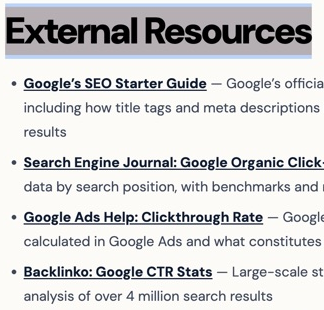
The search marketing metrics resources "click-through rate" guide surfaced DeltaV Digital’s CTR glossary. To reproduce the page check, open that URL and find its External Resources section; search results themselves may change.
That section links to outside material, including Google Ads’ CTR definition and a Backlinko CTR study. This establishes a possible home for a supporting resource. It does not establish a content partnership or endorsement.
Compare that purpose with the CTR guide above. A spreadsheet example for combining campaign totals offers an application step alongside definitions and benchmarks. A suggested addition could be: “For a worked spreadsheet example, see this explanation of combining clicks and impressions.” It should complement the sources, not replace their evidence.
The decision is investigate. Check the current references for an equivalent example, assess the surrounding article’s editorial quality, and look for an appropriate public contact route. The presence of an external-resource list is one useful clue; it does not make every claim on the page reliable or prove the editor wants another link.
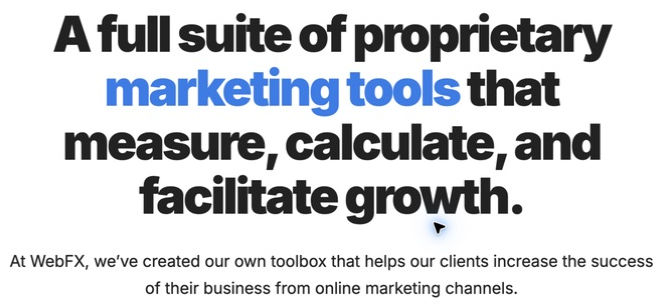
Now compare WebFX’s tools catalog. It lists a CTR calculator, so the topic matches. But the collection describes tools created by WebFX. That is not evidence of a curated list of outside worksheets.
The difference is the page’s job. One page presents outside learning resources; the other organizes the publisher’s own tools. You can identify that distinction before spending time finding email addresses.
Turn candidates into a short contact list
Keep one row per candidate page, not just one row per domain. Save these fields:
Field
Useful entry
Candidate URL
The exact page you inspected
Your resource
The specific destination you would suggest
Placement
The heading or passage where the resource helps
Reader benefit
One concrete task it makes easier
Decision
Contact, check one missing fact, or skip
Next action
The specific check or public contact route
Before moving a page to “contact,” apply three filters:
Fit: its readers need the resource for a task the page actually discusses.
Contribution: the resource adds something useful beyond current references.
Effort: a reasonable next step exists within the time or budget you can spend.
Domain Rating, Domain Authority and traffic estimates can add context. They cannot answer those questions for you. If you use a metric, record the provider and whether it describes the page or the whole domain. A large domain’s traffic does not establish readership for a particular article.
Do not reject a strong editorial fit solely because it uses nofollow. Relevant visitors can still follow the link. Conversely, an ordinary link on an irrelevant page is not automatically worth pursuing. For paid offers, assess audience value, fees and disclosure separately from hoped-for ranking credit.
Deduplicate before outreach. Several candidate URLs may belong to the same publication; choose the best fit and avoid sending near-identical pitches to multiple people there.
Write the useful part of the pitch first
A good prospecting record nearly writes the pitch. You should already know the passage, the gap and the contribution.
Here is a reusable draft. Replace every bracketed item and make sure the stated contribution is true; do not send it unchanged.
text
Subject: A worked example for your [specific topic] guide

Hi [name],

Your section on [specific task] explains [accurate summary].
I put together [resource URL], which shows [concrete addition].
It may help readers who need to [next action].

If that fits your resource section, would you consider including it?

[Your name and connection to the resource]
Keep the request small. Do not demand an anchor phrase, promise mutual ranking gains or pretend to have read a page you have only skimmed. Follow the publisher’s submission preferences, and treat a refusal or lack of fit as a reason to move on.
Run a first session you can learn from
As a starting exercise, choose one resource, try two search approaches and review five candidate pages. These numbers set a manageable work session, not a success benchmark.
Finish with a reason for each decision. If every page is a poor match, adjust the topic or improve the resource before collecting more names. If pages fit but you cannot explain the contribution, the content may need a stronger example or asset. If the shortlist is useful, approach the best fit and learn from the response.
Measure the stages separately: relevant pages found, appropriate contacts reached, replies, placements and useful visits. A large exported list only completes the discovery stage. The goal of prospecting is a smaller set of opportunities you can explain and act on.
Tiny is a co-founder of Tomako, working across the full path from growth strategy to channel execution. His experience spans influencer marketing, affiliate marketing, SEO/GEO, and paid acquisition. As an indie maker and creator, he is especially interested in how small teams can make better growth choices with limited resources. On the Tomako Blog, he writes about channel decisions, practical execution, and lessons from building and growing products.
 Tiny
Tiny