AI CMO for Indie Builders: A Practical Growth System | Tomako
Blog content updates automatically
AI CMO for Indie Builders: A Practical Growth System
An indie builder does not need more marketing tasks. They need a small system that protects build time, picks one useful growth move, and turns real feedback into the next decision.
An indie builder does not need an AI system that creates more marketing tasks.
They need a system that protects build time, chooses one useful growth move, and learns from the result. This is where an AI CMO can help.
For a solo founder, an AI CMO should work like a small growth team with a good memory. It keeps product facts close, watches a limited set of signals, prepares the next move, and records what happened. The founder still owns the product, public voice, promises, outreach, and spend.
Why indie growth work falls apart
Most indie builders do not lack ideas. They lack a clear way to choose.
Useful information sits in many places:
product analytics show where users stop;
support emails repeat the same questions;
search data reveals what people want to know;
community posts show how users describe the problem;
launch notes record what the founder already tried;
competitor changes may affect a buyer's choice.
Then AI adds even more material. It can create 100 ideas, 30 posts, and 10 channel plans in minutes. That output does not prove that the product reached the right person.
READY WHEN YOU ARE
YOUR PRODUCT.
READY TO MOVE.
Bring your product context into Tomako, then turn a guide, an idea, or a decision into work you can continue.
The better goal is one complete learning loop each week.
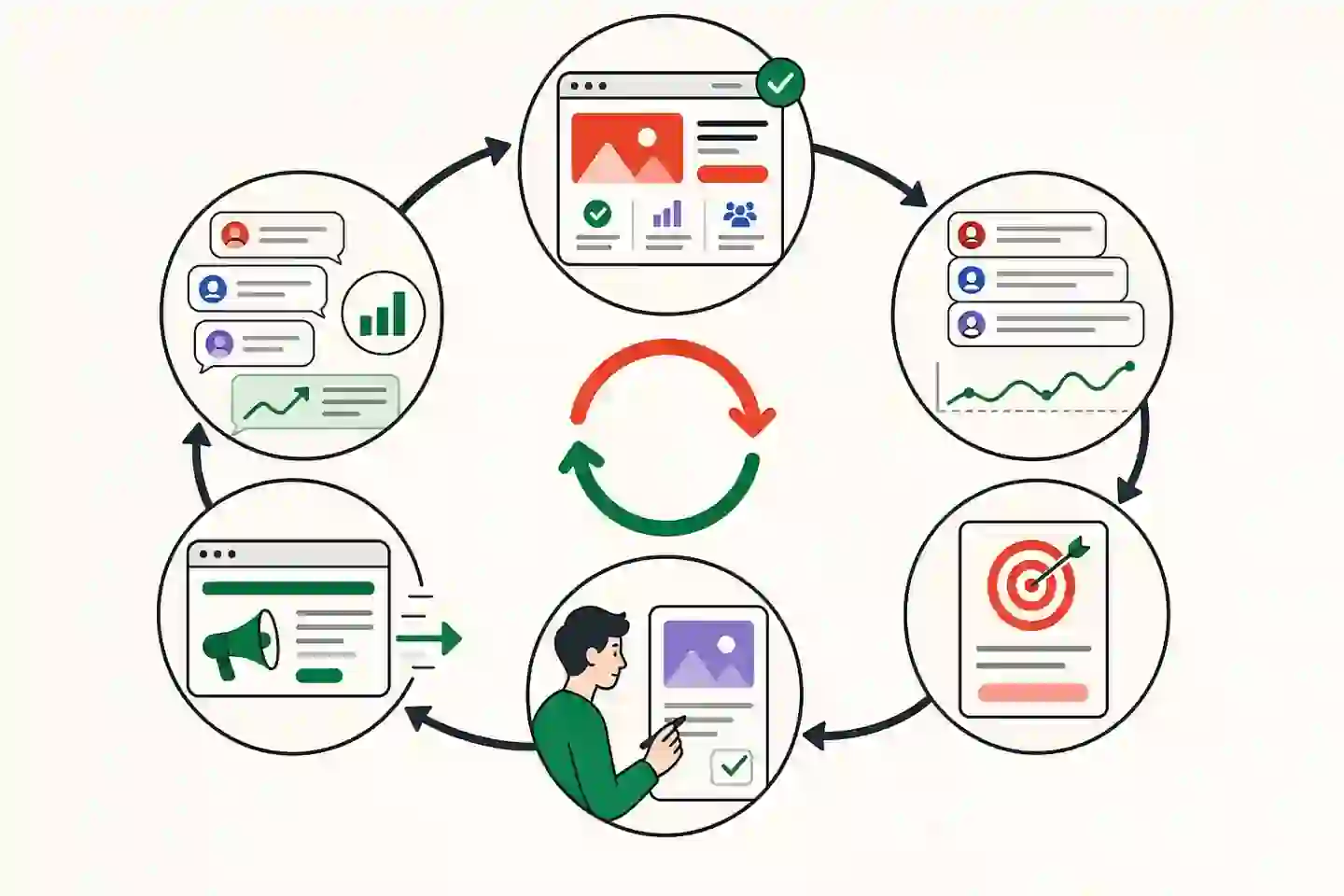
The six-step signal-to-learning loop
The loop starts with a real product and ends with evidence for the next decision.
1. Start with product truth
Keep one short source of truth. It should answer:
What can a user do with the product today?
Which user has the clearest problem?
What proof can you show?
Which claims are safe to publish?
Which limits or open questions should users know?
What can you finish this week?
Do not hide gaps. A missing answer can be useful. It may show that the next task is an interview, not a campaign.
2. Capture a few strong signals
Start with sources close to the user:
repeated support or sales questions;
failed onboarding steps;
search queries that bring relevant visitors;
community discussions with a clear problem;
creator posts that attract your target audience;
competitor changes that affect the buyer's choice.
A useful signal record needs four fields: source, date, exact observation, and why it may matter.
Do not turn every trend into a task. A signal enters the weekly review only when it connects to the current product and audience.
3. Pick one weekly growth bet
Compare a small number of options. Six questions are enough:
Question
What it protects
Does this serve the current audience?
Focus
Is there direct evidence?
Time
Can the product support the claim now?
Trust
Can one person finish it this week?
Capacity
Will the result teach us something?
Learning
Can we pause or undo the action?
Risk
Choose one primary bet. Keep one backup. Archive the rest.
A focused bet could be:
answer one repeated buyer question with a useful page;
ask five matching users to test one onboarding change;
share one build note in a relevant community and request specific feedback;
contact three relevant creators with a research question;
improve one page that already attracts qualified visitors.
4. Prepare work that is easy to review
The AI CMO can turn the chosen bet into a small work package:
the signal and its source;
the target audience and desired action;
a draft page, post, message, or interview guide;
a claim and source check;
a simple measurement plan;
a clear finish line for the week.
The founder reviews the facts, voice, public promise, recipient list, and final action. Review should happen close to the work, not after a large batch has already been produced.
5. Ship within a clear approval boundary
Use three states:
May prepare: research, summaries, outlines, drafts, and internal plans.
Needs approval: publishing, sending messages, changing a live page, or spending money.
Blocked: invented proof, hidden sponsorship, private data access without permission, or claims the product cannot support.
This boundary keeps the system useful without letting speed outrun trust.
6. Save the response and update the next choice
Record what happened in a compact form:
what shipped;
who saw it;
what they did;
what they said;
where the work failed;
what changed in the product or message;
what the next decision should use.
Keep observation separate from interpretation.
"Three of five users failed the same step" is an observation from that test. "The market rejects this flow" is a much larger claim.
A weekly rhythm one person can keep
You do not need a full marketing calendar. Three short sessions are enough.
Monday: choose
Spend 30 to 45 minutes on four things:
Review new product and market signals.
Read last week's result.
Compare up to three possible bets.
Choose one action and one finish line.
Tuesday to Thursday: prepare and ship
Let AI handle bounded research and drafting. Keep the founder review near the final action.
Ship the smallest version that can produce a real response.
Friday: learn
Spend 20 to 30 minutes on observed results, replies, objections, errors, and product changes. Then update the product context or decision rule that should change next week.
Do not judge an entire channel after one test. Judge whether the test produced a useful signal.
A one-page source of truth
The AI CMO needs stable inputs. Keep them on one short page.
Field
Useful answer
Product now
What a user can complete today
Target user
One group with a clear current problem
Approved proof
A demo, measured behavior, or a quote used with permission
Blocked claims
Outcomes that are not proven yet
Current goal
One stage and one time window
Capacity
Time, people, and cash available this week
Open channels
Places where the audience already spends time
Approval owner
The person who may publish, send, or spend
Recent learning
The last result that should change a choice
Update the page when the product or evidence changes. Do not rewrite it for every prompt.
What to automate first
Start with work that repeats and is easy to review:
group recent feedback by problem;
watch a small set of public sources;
build a weekly signal note with source links;
compare a few ideas against fixed limits;
prepare a brief and checklist;
keep a decision and result log.
Wait before automating actions with a larger public or financial cost:
bulk outreach;
automatic public posting;
ad budget changes;
product, legal, or performance claims;
community promotion without a human reading the current rules;
broad access to customer data.
The NIST AI Risk Management Framework is not a marketing guide. Its focus on context, measurement, oversight, and ongoing risk work is still useful here. The system should always show what it knows and who may act.
Match the system to the product stage
Before a usable product
Focus on interviews, problem evidence, and prototype feedback. Do not build a content machine for an untested promise.
Early user testing
Focus on onboarding gaps, repeated questions, activation, and a small number of matching users. Keep public claims narrow.
Early paid product
Focus on qualified acquisition, activation, retention signals, and the questions that stop a buyer from acting.
A working channel
Improve the full path from first contact to product value. Keep one smaller test for a second channel.
When you do not need an AI CMO
Use a simpler option when:
you need one landing page or post;
you already know the next task;
all work happens in one stable workflow;
the product problem is not proven yet;
you cannot review or act on the output.
An assistant, a focused tool, or a simple automation may be enough.
Tomako is an AI CMO for indie builders
Tomako is an AI CMO built for the way software products grow in the AI era. It gives an indie builder one growth system that can keep moving without a separate specialist for every channel.
The system begins with the product, not a blank prompt. Product facts, target users, goals, limits, brand choices, market signals, past work, and results form shared Product Context. Research, content, search, creator work, launches, and outreach can all use that same source of truth.
Tomako then turns context into a weekly growth loop:
It finds signals that connect to the product and its audience.
It compares a small set of opportunities against evidence, impact, effort, risk, and timing.
It turns one chosen opportunity into a brief, plan, draft, check, or launch asset.
It keeps sources and decisions visible so the founder can review the work.
It brings the response and result back into Product Context, so the next week does not start from zero.
For an indie builder, that week feels practical. On Monday, Tomako organizes a few opportunities tied to the product. The founder chooses one. During the week, Tomako prepares the work. The founder checks the facts and decides what goes public. On Friday, the response, data, and product changes shape the next choice.
This is how one person can run a more complete growth system without giving up product control. Tomako can prepare, organize, and advance the work. Publishing, direct contact, budget changes, production edits, and other consequential actions still require human approval.
It can help research and prepare actions. It cannot create demand or guarantee customers. Product value, audience fit, timing, and execution still matter.
How many channels should an indie builder use?
One primary channel is usually enough for a weekly bet. Add another only when you can keep the first loop working and can explain why the second is needed.
Should I let AI post automatically?
Not at first. Let it prepare drafts and plans. Review facts, voice, links, recipients, and community rules before anything goes public.
What should I measure in the first month?
Track decision time, review effort, completed tests, useful responses, source quality, and whether last week's result changed this week's choice.
What if the system keeps giving generic ideas?
Check the inputs. It may lack product facts, a narrow audience, real signals, capacity limits, or past results. If the inputs are clear and the output stays generic, use a simpler tool.
The useful test
An AI CMO earns its place when it helps you complete a better weekly loop with less coordination work.
The loop is concrete: product truth, real signals, one weekly bet, reviewed work, an approved action, and evidence for the next decision.
Tiny is a co-founder of Tomako, working across the full path from growth strategy to channel execution. His experience spans influencer marketing, affiliate marketing, SEO/GEO, and paid acquisition. As an indie maker and creator, he is especially interested in how small teams can make better growth choices with limited resources. On the Tomako Blog, he writes about channel decisions, practical execution, and lessons from building and growing products.
 Tiny
Tiny