AI CMO vs. Fractional CMO: Which Fits Your Team? | Tomako
Blog content updates automatically
AI CMO vs. Fractional CMO: Which Fits Your Team?
Choose a fractional CMO when your company lacks direction or senior marketing leadership. Choose an AI CMO when direction exists but context and daily work keep breaking across tools. Many teams need both.
An AI CMO and a fractional CMO are not two versions of the same hire.
An AI CMO is software. It keeps marketing context, research, priorities, work, and results connected.
A fractional CMO is a senior marketing leader. They join your team for part of their time. They set direction. They align people. They help own the plan.
Choose based on the gap:
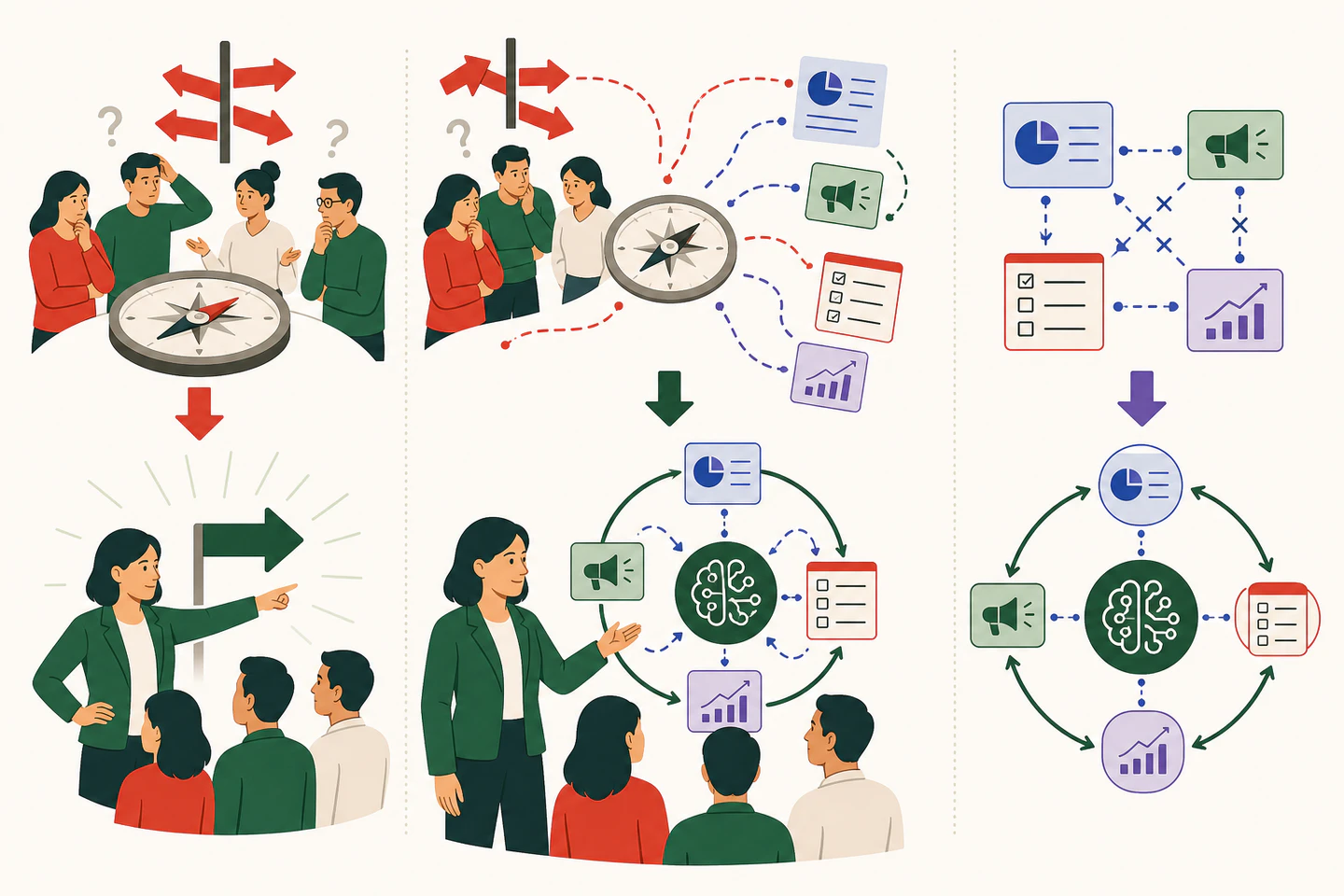
Choose a fractional CMO when no one can make the hard marketing calls.
Choose an AI CMO when the calls are clear, but the work keeps losing context or momentum.
Use both when you need senior direction and a system that can carry it into daily work.
Context, research, execution, and learning break across tools
Direction, positioning, priorities, or leadership are unclear
Strategic judgment
Compares options inside goals and limits set by people
Brings experience to shape goals, tradeoffs, and the marketing plan
Execution
Prepares and connects repeatable work across channels
Leads the plan and may direct employees, agencies, or freelancers
Continuity
Keeps product facts, decisions, and results available between cycles
Adds human memory and judgment during the engagement
Authority
Works inside permissions and approval rules
Can lead people and represent marketing in company decisions
Accountability
Produces a traceable work trail; a human still owns the outcome
Can own agreed marketing outcomes, while company leaders retain final responsibility
Cost shape
Software, setup, integration, context upkeep, review, and error handling
Retainer or project fee, onboarding, team support, and execution resources
Common failure
More output without better decisions or follow-through
Senior advice with no team or system able to execute it
Best use
Turn a known direction into a repeatable operating loop
Decide the direction and build the marketing function
The short version is simple. A fractional CMO can lead. An AI CMO can keep the work moving. It can also save what the team learns.
Choose by bottleneck, not by title
Look at the last three marketing goals that stalled. Find the first point where each one broke.
Leadership bottleneck: The team cannot agree on audience, positioning, priorities, budget, or success.
Judgment bottleneck: Many options look possible, but no one can make a confident tradeoff.
Context bottleneck: Product facts and past decisions get lost between tools, people, and prompts.
Execution bottleneck: Good research and plans rarely become review-ready work.
Learning bottleneck: Results are reported, but they do not change the next decision.
Capacity bottleneck: The strategy is sound, but a narrow task needs more hands.
A leadership gap points toward a fractional CMO. The same is true for a judgment gap. Context, work, or learning gaps point toward an AI CMO.
A capacity bottleneck may need neither. A specialist, agency, focused AI tool, or simple automation may be a better fit.
The right choice depends on where marketing stops, not which title sounds more advanced.
When an AI CMO fits better
An AI CMO is a strong fit when the team already has an owner and a usable direction.
Look for these signs:
Someone can state the audience, goal, time window, and limits.
The product is real enough to provide facts, feedback, usage, or sales signals.
Research, priorities, drafts, and results live in separate tools.
People repeat the same product context every time they start a new task.
Useful research often stops before it becomes work someone can review.
The team makes choices across search, content, creators, communities, launches, or other channels.
Someone can approve public claims, outreach, spending, and live changes.
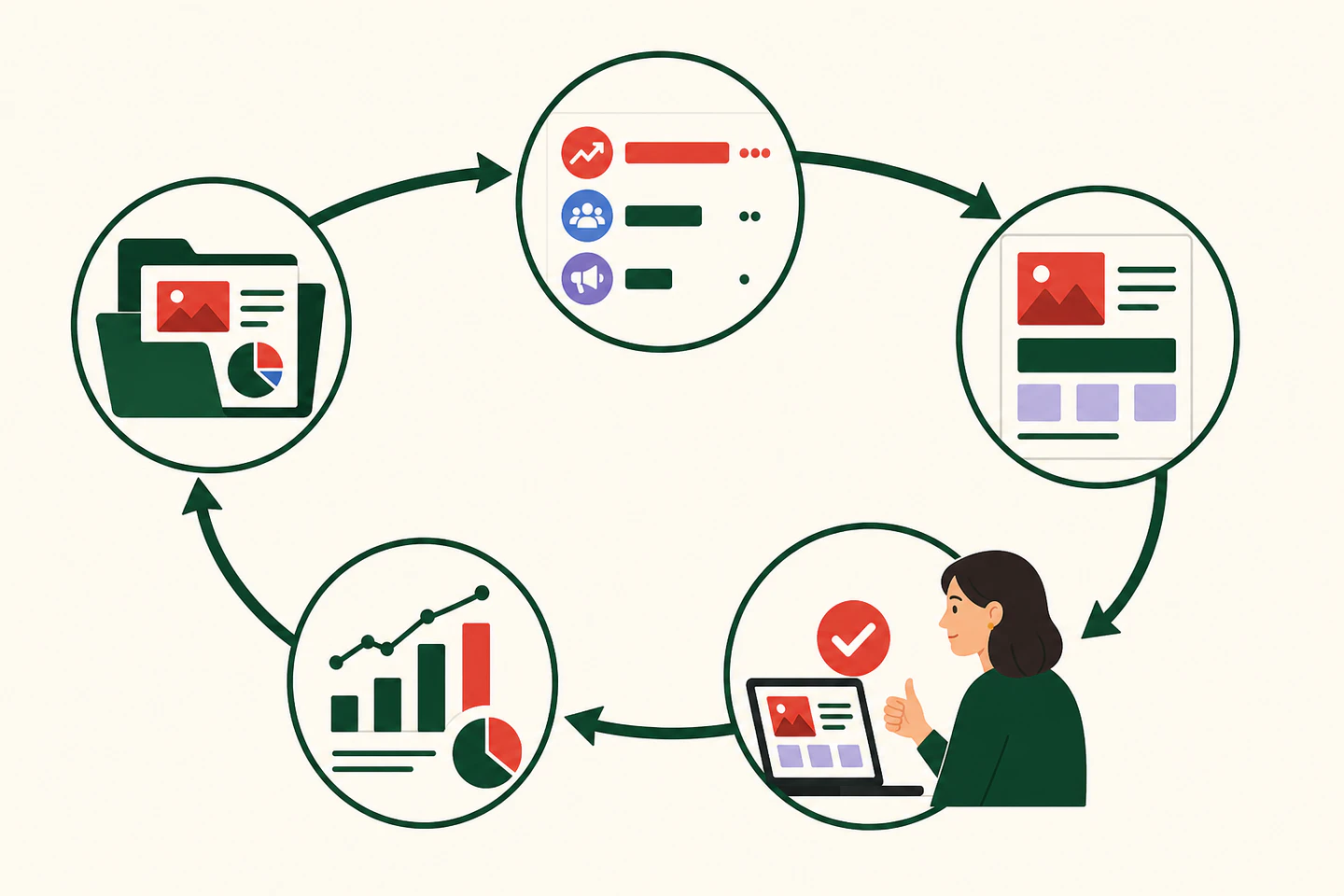
The goal is not to create more assets. It is to connect one full loop:
product context → market signal → priority → reviewable work → human approval → result → next decision
If that loop improves, the system is doing more than helping with one task.
When a fractional CMO fits better
A fractional CMO fits when your team needs leadership first. More output will not fix that gap.
Common signs include:
founders do not agree on who the product is for;
positioning changes with every sales call;
no one can say which channel should come first;
marketing has activity but no clear plan;
agencies or freelancers receive conflicting briefs;
the company needs a senior voice in product, sales, or budget decisions;
the team needs hiring, coaching, or a new operating rhythm.
Software can sort evidence and compare options. It cannot resolve founder conflict. It cannot build trust with a team. It cannot coach a manager or carry executive power.
A good fractional CMO should leave the team in a better state. Choices should be clearer. Owners should be named. The team should have a plan it can run.
When the hybrid model is strongest
Some teams have both gaps. They lack senior direction. Their daily work is also split across tools.
In that case, the two roles can reinforce each other:
Fractional CMO owns
AI CMO supports
Positioning and strategic choices
Keeps approved product and market context connected
Channel priorities and resource tradeoffs
Finds and compares opportunities inside those limits
Team roles and decision rights
Prepares briefs, drafts, checks, and task plans
Review standards and escalation rules
Routes work for review and records what changed
Executive communication
Turns results into inputs for the next cycle
The human leader should not become an expensive prompt writer. The software should not pretend to be the executive.
The hybrid works when each side has a clear job. People set direction and own the result. The system carries context. It prepares work and saves what the team learns.
If neither option fits, choose a smaller fix
Do not buy an operating system when one task is slow. Do not hire an executive when the plan is already clear and only needs more hands.
What keeps breaking?
Start with
One narrow task takes too long
Focused AI tool or specialist
A marketer needs research or draft support
AI assistant
The same stable steps repeat
Marketing automation
One bounded workflow changes with new evidence
AI agent
A clear plan needs more production capacity
Freelancer or agency
Direction and ownership are missing
Fractional CMO
Cross-channel context and follow-through keep breaking
AI CMO
This is not a maturity ladder. A capable team may use several options at once.
Test an AI CMO with one 30-day loop
Do not ask a new system to “run marketing.” That creates too many variables.
Choose one workflow that repeats. It must matter to the business. It should use at least two sources. It must end in work a person can approve. It should create useful learning within 30 days.
A useful test question is:
Each week, which one search, creator, launch, or community opportunity deserves action? Can the system turn it into review-ready work?
Before day one: record the baseline
Review three similar past choices. Record the time from signal to decision. Note how often the team repeated context. Mark what reached the end. Check whether the result shaped later work.
Week 1: build the shared context
Add the product, audience, position, goals, and limits. Add approved claims and name the review owner. Ask the system to restate the facts. Then ask it to mark gaps.
Week 2: test opportunity quality
Ask for a short ranked list. Each option should show its source and target user. It should state why now is a good time to act. It should also show effort, needs, risk, and timing.
Week 3: prepare one real action
Choose one option. Ask for work your team can inspect. It may be a brief, page outline, draft, outreach note, task list, or measure plan.
Week 4: close the learning loop
Record what the team accepted. Note what changed and what shipped. Save the result. Then ask how it should change the next choice.
A useful test improves decisions and completion, not output volume.
Measure which ideas pass review. Track decision time and review effort. Track what gets done. Check the sources and note errors. Then compare the result with your own baseline, not a vendor claim.
Evaluate a fractional CMO with the same discipline
A fractional CMO may not offer a free trial. You can still ask for proof before signing. You can also set a clear scope for the first month.
During interviews, references, and early work, look for:
Diagnosis quality. Do they identify the real business constraint, or jump to their favorite channel?
Decision logic. Can they explain why one audience, message, or channel comes before another?
Relevant experience. Have they handled a similar market, stage, team, or constraint?
Ownership design. Is it clear what they decide, what the founder decides, and who executes?
Working plan. Does the first month produce decisions and operating habits, not only a deck?
Collaboration. Can they challenge leaders, coach the team, and work with sales and product?
Exit value. Will the team retain a clearer system, stronger people, and usable records after the engagement changes?
Bring your real product, numbers, constraints, and team map. A polished generic pitch is not enough.
Compare total operating cost, not the headline price
Do not compare a software plan with a leader's fee and call the lower number the winner. The two options include different work.
For an AI CMO, count:
software + setup + integrations + context upkeep + human review + error recovery − work that is truly retired.
For a fractional CMO, count:
leadership fee + onboarding + internal team time + outside help for execution − management work and poor decisions that are truly reduced.
The cheapest option can become expensive if the team must repair its output or cannot act on its advice.
Compare both against the same business result. Can the team move one sound idea from proof to an approved test? Can it use the result in the next choice?
Human control is part of the buying decision
For any AI CMO, ask what the product can read, prepare, publish, send, change, and spend.
require approval for public content, outreach, live changes, and money;
block invented claims and unauthorized data use.
A fractional CMO also needs clear rights. Agree on budgets, hiring, and agency control. Set rules for public claims. State which choices still belong to the founder or senior team.
Where Tomako fits
Tomako is the AI CMO in this guide. It is a marketing system built for software teams in the AI era.
Its purpose is to keep the whole marketing loop connected. Product facts should not vanish between tools. The same is true for users, goals, limits, market signals, past choices, approved work, and results. Each task should not start from a blank prompt.
Tomako brings five parts of the job into one system:
Product context that stays available across marketing work.
Growth signals from search, customers, competitors, creators, communities, and launches.
Prioritization based on evidence, impact, effort, risk, timing, and team limits.
Review-ready briefs, plans, drafts, checks, and task flows that move decisions forward.
A learning record that uses accepted work, changes, results, and rejected ideas to improve the next cycle.
Tomako does not need to replace a strong marketing leader. It gives that leader a system for context and daily work. It can carry each choice into a repeatable flow. A founder-led team can use the same layer when its direction is clear. It does not need to add more tools that fail to connect.
The team still controls consequential actions. Publishing, outreach, spending, production changes, and public claims require human approval.
Tomako builds the AI CMO described here. We have a clear interest in this comparison. Use the same tests for Tomako and every other option. Check the quality of each choice. Check the sources, review effort, and work done. Most of all, ask if each result improves the next decision.
Start with the free GTM Readiness Checklist. It helps separate a direction problem from an evidence or execution problem.
Not when the main gap is leadership. Software can support research, priorities, work, and learning. It cannot hold human authority. It cannot coach a team, resolve founder conflict, or accept senior duty.
Can a fractional CMO replace an AI CMO?
A strong leader can design the process. The team may still face split tools, repeated context, and weak follow-through. Ask if the team has a system that carries the leader's choices into daily work.
Is an AI CMO the same as an AI marketing agent?
No. An agent usually owns a bounded task or workflow. An AI CMO connects several marketing workflows through shared context, priorities, review, and learning.
Which option is cheaper?
The cost structures are different. Compare the full operating burden and the result you need. Do not compare only a subscription with only a leadership fee.
Can a small team use both?
Yes, if both gaps are real. Keep the scope clear. The fractional CMO sets direction and decision rules. The AI CMO carries context, prepares work, and records learning.
The decision in one sentence
Choose a fractional CMO when the team needs marketing leadership. Choose an AI CMO when it needs a connected operating system. Use both when direction and execution are breaking at the same time.
Related tools
Continue with a tool for the next decision or task in your workflow.
Eren is the founder of Tomako, focused on the decisions that shape SaaS and AI products—from defining a problem and building the product to refining the user experience. As a product manager, product designer, and developer, he looks at products through the combined lens of user needs, positioning, interaction design, and implementation. His writing covers product insight, validation, onboarding, positioning, and how to turn complex ideas into useful product experiences.
 Eren
Eren