AI CMO vs ChatGPT for Product Marketing in 2026 | Tomako
Blog content updates automatically
AI CMO vs ChatGPT for Product Marketing in 2026
Use ChatGPT when a marketer already owns the next decision. Add an AI CMO when the same decision keeps losing context between research, prioritization, execution, review, and learning.
ChatGPT often wins the first five minutes of product-marketing work. Give it a launch brief, a few customer quotes, and a clear request, and it can help you explore messages, draft a page, or challenge an assumption. OpenAI's marketing workflow guide lists writing, research, brainstorming, and data analysis among the ways marketing teams can use ChatGPT (OpenAI Academy, Learn ChatGPT workflows for marketing teams).
ChatGPT Projects can also keep chats, files, and project instructions together for recurring work (OpenAI, Projects in ChatGPT).
That makes ChatGPT a strong marketing assistant. It does not automatically settle a different problem: how a team turns signals into one priority, moves the approved work forward, and records what it learned.
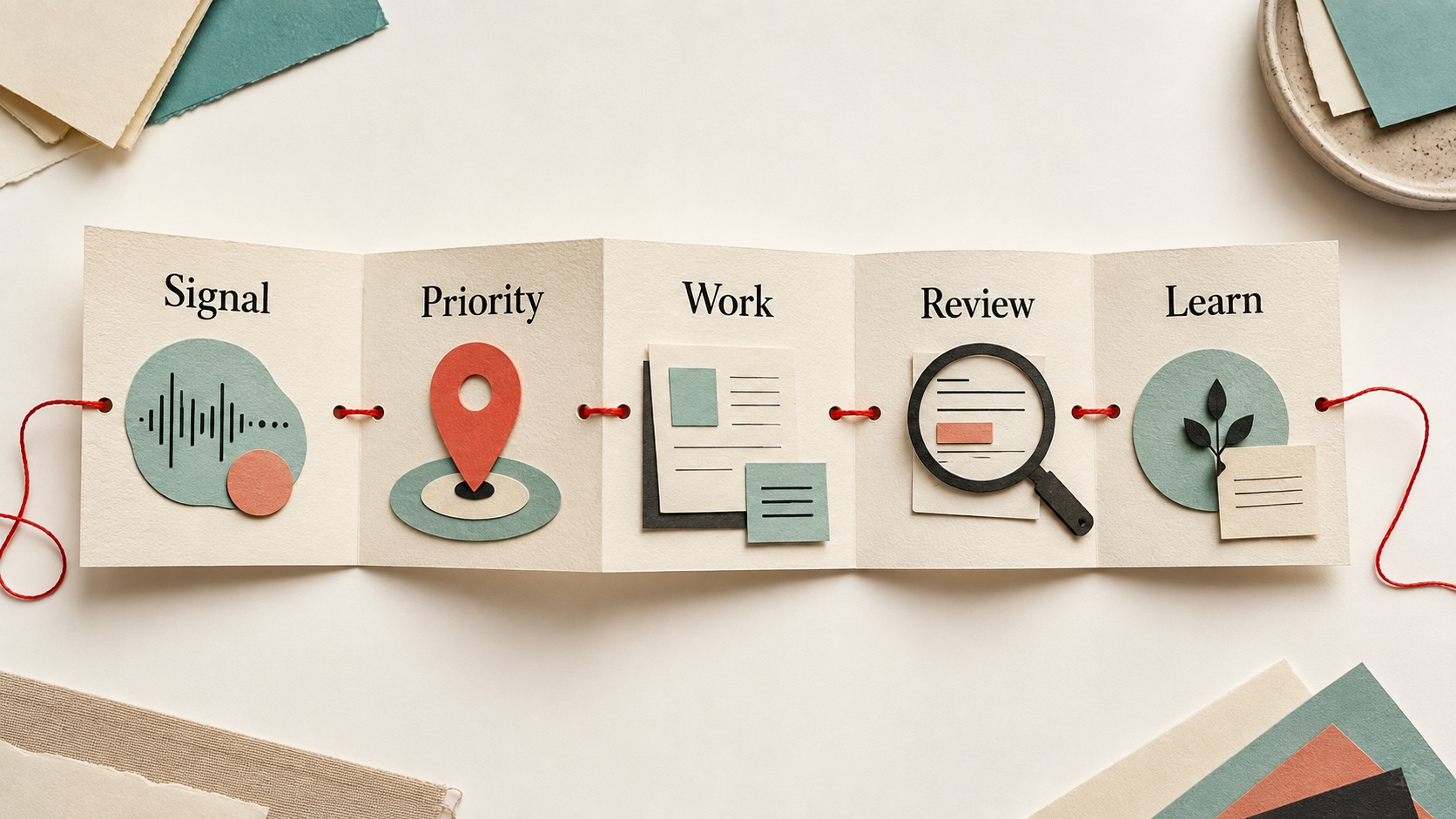
That is the useful distinction in an AI CMO vs ChatGPT comparison. AI CMO is a category label for a connected marketing operating model that keeps context, signals, priorities, work, and learning in view. It is not a universal product standard. Tomako's definition of an AI CMO uses those five jobs as the test.
Choose ChatGPT when a marketer already owns the next decision and needs sharper research, options, or drafts.
Choose an AI CMO when the same decision keeps losing context between research, prioritization, execution, review, and learning.
Use both when their responsibilities are clear: one can help create work, while the other preserves the operating loop around it.
Do not buy either system to solve missing direction, unapproved claims, or absent human ownership.
Decision lens: Compare operating responsibility, not generic AI features. ChatGPT supports a marketer's task. An AI CMO should preserve the team's decision across the work that follows.
The quick comparison: what actually breaks?
The right choice depends on the first point where useful marketing work stops. The table below compares operating responsibilities, not generic feature checkboxes.
Decision point
ChatGPT
AI CMO
Better fit
Turn a supplied brief into options or a first draft
A marketer supplies the brief, evaluates the answer, and iterates in chat.
May support this work, but it is not the reason to add a system.
ChatGPT
Keep a working project context together
Projects can organize chats, files, and instructions for repeated work.
Should retain business context as part of a wider operating loop.
ChatGPT, for a bounded project
Turn several signals into one visible priority
The user asks for the comparison and must carry the decision forward.
The system should connect signals, goals, constraints, and a ranked next move.
AI CMO
Carry an approved choice across channels and handoffs
The team recreates or pastes context into each next task.
The operating model should preserve the decision, owner, evidence, and approval state.
AI CMO
Keep a human responsible for claims, spend, publishing, and strategy
Possible when the user sets the review process.
Possible only when approval rules and accountable owners are explicit.
Tie: process design matters
Start with the least extra process
Open a project, attach context, and work with a marketer's judgment.
Requires a defined goal, usable inputs, and a loop worth connecting.
ChatGPT
An AI CMO earns its place when one decision can remain inspectable across all five stages, rather than being recreated in a new chat or tool at each handoff.
The practical answer is not that one tool is “smarter.” The tools carry different amounts of operating responsibility.
ChatGPT wins when a marketer already owns the next decision
Winner: ChatGPT. It is the better starting point when a person can name the audience, choose the next move, and judge whether the result is useful. In that situation, the bottleneck is usually the quality or speed of one thinking task, not the marketing system around it.
Use ChatGPT when the work looks like this:
turn a founder's notes into three positioning angles;
summarize interview transcripts before a planning meeting;
produce alternatives for an onboarding email, landing page, or launch narrative;
find gaps in a brief that a product marketer will own;
prepare a research memo from documents the team has already selected.
Projects make this mode more durable. OpenAI says a Project can group the files, instructions, and chats for a long-running effort, so the assistant has the material needed to stay on topic (OpenAI, Projects in ChatGPT). That reduces repeated setup for a project that is still led by a marketer.
The limit is easy to miss: stored context is not the same as a decision system. Someone still needs to decide which signal matters, what the team will not do, who approves a claim, and how the outcome changes next week's work.
Verdict: use ChatGPT when the human decision is present and the task around it needs help. Do not add a heavier operating layer just to generate better first drafts.
An AI CMO earns its complexity at the handoffs
Winner: AI CMO. An AI CMO becomes useful when the same decisions repeatedly break between stages. Research may be good, but no priority is chosen. A priority may be chosen, but the brief loses its evidence. Work may ship, but nobody links the result to the next decision.
That is not a copywriting issue. It is a continuity issue.
An AI CMO should make five objects visible:
Context: the product facts, audience, goal, approved claims, limits, and previous choices that define a safe decision.
Signals: the customer, market, search, creator, competitor, or campaign inputs that justify action.
Priority: the next recommended move, plus the evidence, tradeoff, owner, and reason it outranked other ideas.
Work: the reviewable brief, draft, task, or experiment created from that approved decision.
Learning: the recorded outcome, uncertainty, and next question after the work is complete.
These are the five jobs in Tomako's AI CMO model (What Is an AI CMO?). The value is not that every job happens automatically. The value is that a team can inspect the chain, correct it, and avoid reconstructing the same rationale at every handoff.
Verdict: choose an AI CMO when preserving decisions across a changing marketing loop matters more than improving a single task. If a product cannot show how these five objects connect, it is probably an assistant or workflow tool with a bigger label.
The handoff test separates a helpful chat from an operating loop
The quickest way to compare the two approaches is to audit one recent marketing decision. Pick work that involved more than one source and more than one person or channel, such as a launch, a content opportunity, a creator test, or a positioning change.
Then ask four questions:
Can a new reviewer see the goal, evidence, constraints, and rejected options without reading a long chat history?
Can the approved decision become a brief or task without someone re-explaining why it matters?
Can the owner see which action is waiting for review, publishing, outreach, spend, or another consequential step?
After the work is done, can the team point to what changed and use that learning in the next choice?
The handoff audit: if these five fields do not travel together, the next person has to reconstruct the decision instead of reviewing it.
If the answer is yes because one strong marketer keeps the work in their head, ChatGPT may be enough. If the answer is no because each transfer deletes the reason behind the work, the missing piece is an operating loop.
This test also prevents a common mistake: comparing a chat interface with a broad marketing promise. The fair comparison is between a human-led, task-oriented workspace and a connected decision system. Both can include AI. They are not meant to own the same layer of the work.
Human approval is a requirement, not a feature column
Winner: tie. Neither ChatGPT nor an AI CMO should replace accountable judgment on product claims, brand direction, budget, publishing, outreach, or a strategic bet. The useful question is whether the workflow makes ownership visible before a consequential action happens.
A healthy review path names:
the person who owns the business goal;
the evidence that supports the proposed action;
the person allowed to approve, reject, or change it;
the limits on what can happen automatically;
the observation that will count as learning afterward.
ChatGPT can support that process if the team supplies it. An AI CMO should make the process easier to keep consistent as more work and more channels enter the loop. Neither tool fixes a team that has not decided who can say yes, who can say no, or what success means.
Verdict: reject any evaluation that treats autonomy as the outcome. Better marketing systems make a responsible human faster and better informed.
Run a 10-day decision test before committing to a system
Do not ask either tool to “run product marketing” and then judge vague impressions. Choose one recurring decision that can create useful learning in ten days.
Days
What to do
What to inspect
1–2
Define one goal, audience, constraint, accountable owner, and approval rule.
Is the decision concrete enough to review?
3–5
Gather the small set of inputs that could change the decision.
Are the sources current, attributable, and relevant?
6–7
Ask for a recommendation, alternatives, and a review-ready work item.
Can a reviewer understand the reason for the recommendation?
8–10
Complete or deliberately stop the approved action, then record the result and next question.
Did the reasoning survive the handoff and produce a usable learning?
For a ChatGPT test, make the marketer responsible for assembling context and carrying the decision across each step. For an AI CMO test, inspect whether the system makes that continuity more visible and less dependent on memory. This is a workflow comparison, not a performance benchmark. It does not promise traffic, conversion, or revenue.
Use the AI CMO readiness guide to diagnose whether a missing task tool, a stable automation, an adaptive workflow, or a connected system is the actual constraint.
Who should choose what?
A founder or product marketer with a clear next move: Choose ChatGPT first. You have the direction; you need help turning notes, research, and judgment into better work.
A small growth team with repeated cross-channel handoffs: Evaluate an AI CMO. The problem is likely not a lack of ideas. It is that evidence, priorities, and results reset when work moves between people or tools.
A team with a stable, repetitive process: Start with automation. A fixed process does not need a broad decision layer just because AI is available.
A team without a product truth, a growth owner, or approval rules: Pause the tool evaluation. Write down the product facts, choose the owner, and define one decision that matters. Software cannot create accountable direction on its own.
Frequently asked questions
Is ChatGPT an AI CMO?
ChatGPT can be part of an AI CMO workflow, especially for research, drafting, and structured thinking. It becomes an AI CMO only if the surrounding system also keeps context, prioritizes action, moves approved work through review, and connects outcomes to the next decision. The label matters less than the operating loop.
Can a product-marketing team use ChatGPT and an AI CMO together?
Yes. A practical split is to use ChatGPT for collaborative analysis and asset creation, while the AI CMO records the decision context, prioritizes work, and preserves learning across the workflow. The handoff must be explicit, or the team will recreate the same context twice.
What should we prepare before testing an AI CMO?
Prepare one real goal, a defined audience, accurate product facts, approved claims, a small set of relevant inputs, and a person who can approve consequential actions. The AI CMO guide for indie builders offers a lightweight weekly cadence for teams that need to start smaller.
Verdict: choose the smallest system that keeps the decision intact
Category
Better fit
Drafting, research support, and option generation
ChatGPT
A bounded workspace with files, chats, and instructions
ChatGPT Projects
Cross-channel prioritization and decision continuity
AI CMO
Human approval and strategic accountability
The team, supported by either tool
A marketing operation without clear direction
Neither: fix ownership first
ChatGPT is the better first choice for product marketers who know what needs deciding and want an adaptable assistant beside them. An AI CMO is the stronger fit when the organization needs the decision itself to survive every handoff, from evidence to action to learning.
Before comparing screens or prompts, compare the work that keeps breaking. That tells you whether you need a better assistant, a repeatable workflow, or a connected marketing system.
Related tools
Continue with a tool for the next decision or task in your workflow.
Eren is the founder of Tomako, focused on the decisions that shape SaaS and AI products—from defining a problem and building the product to refining the user experience. As a product manager, product designer, and developer, he looks at products through the combined lens of user needs, positioning, interaction design, and implementation. His writing covers product insight, validation, onboarding, positioning, and how to turn complex ideas into useful product experiences.
 Eren
Eren