How to Run an Influencer Marketing Campaign: 7 Steps | Tomako
Blog content updates automatically
How to Run an Influencer Marketing Campaign Without Losing the Thread
To run an influencer marketing campaign, define one objective and budget, choose the campaign format, evaluate creators, agree on commercial terms, approve a brief and disclosure, test tracking, then launch and record what to change. This guide is for brands and lean marketing teams running their first campaign—or trying to make the next one easier to manage.
Choose the campaign format and each creator’s role.
Build a candidate pool and evaluate creator evidence.
Send outreach and agree on compensation, rights, and contract terms.
Write a testable brief, with approvals and sponsorship disclosure.
Verify links, codes, attribution, and launch readiness.
Launch, report against the original objective, and record your next decision.
Keep the decisions in one Campaign Control Sheet. By the end, you will have a working record connecting why you hired a creator to what you approved, measured, and learned.
Explanatory illustration; not a product screenshot.
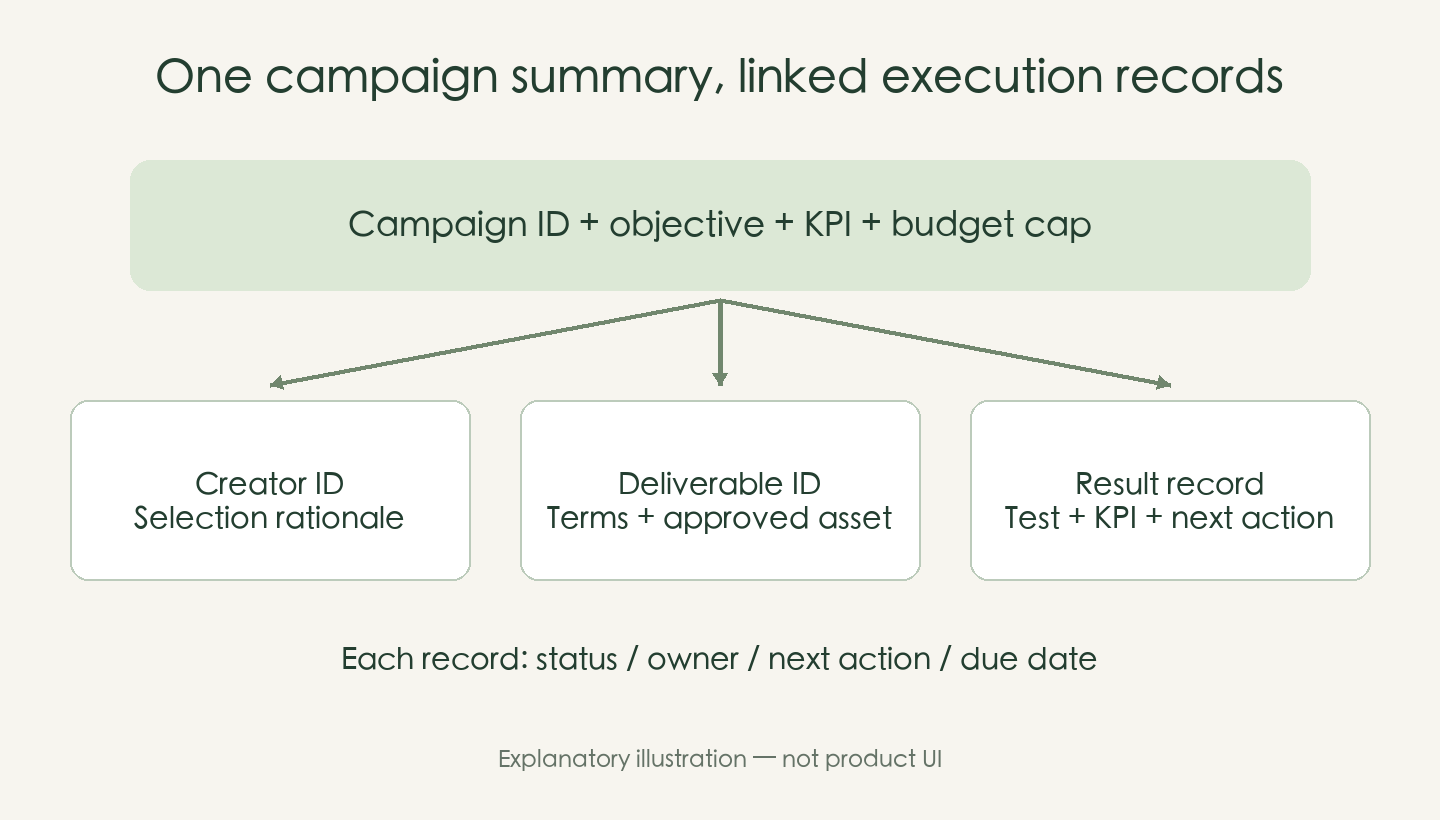
Use a spreadsheet or shared document. Create a campaign summary and one execution row per deliverable, connected by campaign and creator IDs. Store supporting documents separately and link to them instead of pasting every message into the sheet.
Keep the supporting records connected:
Objective → creator rationale → agreed scope → approved content → tracking evidence → result → next decision.
This is the campaign’s proof chain: a record of why decisions were made and whether the agreed work happened. It does not prove that the campaign caused a sale.
Deliverable ID; format; fee; other costs; payment milestones; rights; exclusivity; agreement link
Production approval
Brief version; message hypothesis; supported claims; disclosure plan; approver; final asset link; approval time
Launch verification
Destination; creator link/code; attribution rule; test evidence; publication time and time zone; go/hold decision
Results and learning
Live URL; reporting source; actual spend; primary KPI; data gaps; decision; next owner and action
Add status, next action, owner, and due date to each execution row. In a one-person team, the owner can be the same throughout; the fields still make unfinished work visible.
Use the approval checks below to decide when work can move forward. They are a practical planning framework, not industry benchmarks.
Explanatory illustration; not a product screenshot.
Step 1: Set one primary objective, KPI, and budget cap
Write the customer action you want before deciding who to hire. “Build awareness and generate sales and collect content” leaves you with several competing definitions of success.
Choose one primary objective. Keep other outcomes as secondary observations.
Primary objective
Possible primary KPI
Define before launch
Reach a relevant audience
Reported reach for the agreed content
Reporting source and limits on audience qualification or deduplication
Generate leads
Qualified inquiries
Qualification criteria and duplicate handling
Acquire customers
Attributed new-customer orders
Attribution rule, customer status, exclusions, and cutoff
Produce reusable creative
Assets accepted against the brief
Acceptance criteria and the usage scope purchased
A number becomes a usable KPI when two teammates can calculate it the same way. For orders, decide whether cancellations and refunds are excluded and when the count closes. For leads, define what qualifies before the inquiries arrive.
Build the budget from the work required: creator fees, product cost, shipping, production support, rights, incentives, tools, and internal time where you intend to count it. Keep committed, estimated, and actual costs separate. Name a reserve amount rather than treating every available dollar as a creator fee.
Set the target from your own economics and acceptable learning cost. Do not reverse-engineer a flattering target after seeing results. If your target is exploratory, label it that way.
Before moving on: The budget owner approves the KPI definition, target, cost scope, and spending cap. Record them before outreach.
Step 2: Choose the campaign format and creator role
Describe the job of the content. Does a customer need to see a product used, understand a trade-off, encounter the brand, or act on a specific offer?
Then choose a format that can do that job:
Customer need
Format to consider
Creator’s job
Understand how something works
Demonstration or tutorial
Show a credible use case
Resolve a purchase question
Explanation or comparison
Address a defined objection honestly
Discover the brand
Sponsored story or introduction
Make the product relevant to an existing conversation
Respond to an offer
Promotion with a trackable destination
Explain the offer and next action
Supply brand creative
Commissioned content
Deliver assets for the agreed usage scope
These are options to evaluate, not claims that one format always performs better. A creator producing content for your channels has a different role from a creator publishing to their own audience. Specify whether you are buying production, distribution, or both.
For a first pilot, choose a scope your team can review and support. One clear concept with a few suitable creators is a reasonable starting design, but there is no universal creator count. Product delivery, feedback rounds, and reporting requests all create work.
Write a message hypothesis: “Showing the lunch container inside a packed work bag will help customers judge its size.” That sentence later belongs in the brief and report.
If you need ideas for demonstration angles or purchase objections, use how to research competitor ads. Treat the examples as prompts for your own hypothesis, not evidence that a format will work for your campaign.
Before moving on: Every proposed deliverable has a customer need, creator role, format, and action. Remove deliverables whose only rationale is that another campaign used them.
Step 3: Build a candidate pool and evaluate creator evidence
Find plausible candidates through relevant content, existing brand relationships, or suitable creator discovery tools. For detailed search methods, use how to find influencers. For an Instagram-specific campaign, see how to find Instagram influencers by niche.
Your task here is to decide who can execute this campaign. Keep the review compact and consistent. Use an evidence card to connect observed work with the proposed assignment:
text
Creator ID and profile:
Proposed campaign role:
Relevant content links and review date:
What the content demonstrates:
What supports audience fit:
What remains unverified:
Commercial or scheduling questions:
Selection decision and reviewer:
Implication for the offer and brief:
Separate observation from inference. “Three recent videos demonstrate packed lunches” is an observation. “Their viewers are US office workers” remains a hypothesis unless you have suitable evidence. Creator location alone does not settle audience location.
Review multiple comparable pieces rather than selecting someone from one standout post. If audience composition matters, request a recent aggregate audience report from the creator. Record its source and coverage; do not describe it as an independently audited fact.
Use three decisions: shortlist, hold for an answer, or decline. A missing answer about availability or rights should remain visible even when the creative fit looks strong. For a deeper selection process, see how to choose influencers for your brand.
Keep contact records limited to relevant business information. Prefer a business contact route the creator has published or provided, record its source, and keep payment and personal documents out of the general campaign sheet. Follow your organization’s approved data-handling process for collecting, storing, and using contact information.
Before moving on: Each shortlisted creator has evidence, a specific role, and a next action. Carry the selection rationale into outreach instead of starting again with a generic compliment.
Step 4: Send outreach and agree on the commercial terms
Your opening message should make the opportunity easy to evaluate: why this creator, what you want, when you need it, what you can pay, and which rights you want to discuss.
Hi [name]—your [specific content] showed [relevant approach]. We’re planning a campaign for [customer/product], and think [concept] could suit your audience. We’re proposing [deliverables] during [window], with a budget of [range]. The proposed rights are [scope]. Are you interested and available? If so, I can share the brief and confirm your rate and terms.
Send the final offer only after reconciling the scope with the budget. Compare offers against the same deliverables, revision allowance, and usage scope. Then update committed costs before accepting an offer.
Resolve these items in a written agreement:
Deliverables: quantity, format, publishing account, deadlines, and how long content should remain available.
Compensation: fee, product provision, expenses, any commission calculation, payment triggers, and timing.
Usage: ownership and the permission sought for each channel, territory, duration, edit, and paid placement.
Exclusivity: restricted competitors or categories and the exact period, if applicable.
Production: feedback rounds, approval deadlines, handling of delays, and what counts as extra work.
Completion: reporting deliverables, cancellation arrangements, and a process for correcting a problem.
Treat this as an issue checklist for your agreement, not contract language. Do not assume a publishing fee includes permission to run the content as an ad. Write the requested usage explicitly and reconcile it with the signed terms.
Store the agreement link and approved commercial summary in the control sheet. Keep payment credentials in the appropriate restricted system.
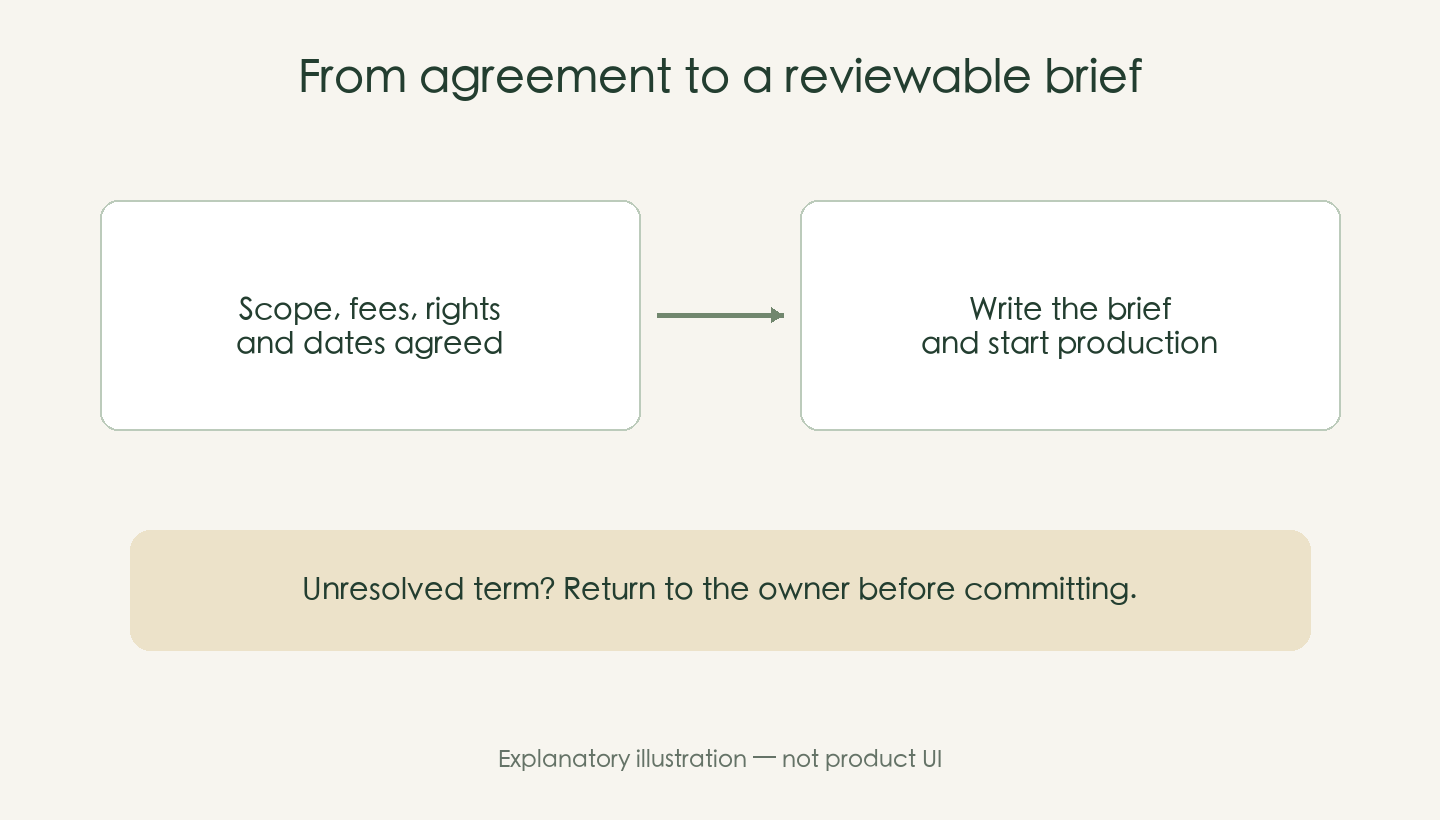
Before moving on: Both parties have agreed to the scope and terms. Any new deliverable, usage request, or fee returns to the budget owner before it becomes a commitment.
Explanatory illustration; not a product screenshot.
Step 5: Write a testable brief, with approvals and disclosure
A useful brief explains the customer problem and what the content must accomplish while leaving room for the creator’s voice.
Include the message hypothesis from step 2, the selection rationale from step 3, and the agreed deliverable from step 4. Then add:
Product access and time to use it before production.
Required factual details, supporting references, and claims to avoid.
The demonstration or question the content should address.
The call to action and approved destination.
Disclosure wording and placement for the format.
Draft deadlines, the approver, feedback rounds, and the final approval process.
Make acceptance criteria observable. “Make it engaging” gives the reviewer little to check. “Show the container next to a familiar object, identify the size, and explain where to see the dimensions” is reviewable.
Build disclosure into the content
The FTC says material brand connections—including payment or free products—need disclosure. Put it with the endorsement, where viewers will notice it, rather than behind “more” or among hashtags. Use clear language such as “ad” or “sponsored.” For video, include disclosure in the video; audio and visual disclosure together are more noticeable. For image Stories, superimpose readable disclosure. Repeat it periodically during livestreams. Do not assume a platform label is sufficient by itself. Endorsements must reflect genuine experience and avoid claims the advertiser cannot support. See the FTC’s Disclosures 101 guidance.
Give one person responsibility for consolidating feedback. Conflicting comments from several teammates can quietly turn one revision round into a rewrite.
Before moving on: The approver signs off on an identifiable final version. Record the asset, caption, disclosure plan, and approval time. A change to a product claim or offer needs another review before publication.
Step 6: Verify tracking and launch readiness
Decide how you will assign credit before the first post appears. For a small sales campaign, document the creator link, any code, the conversion event, the reporting period, and the rule for overlapping signals.
For example, a customer might click one creator’s link and use another creator’s code. Write which signal receives credit, or how you will label the conflict. Do not count the same order twice in the campaign total.
Treat the attribution rule as a reporting convention. It does not establish that every credited purchase was caused by the campaign. For implementation detail, use how to track influencer conversions.
Campaign launch checklist: copy or print
Use one copy per creator deliverable before the sponsored content goes live.
Even if you manage the campaign on desktop, test the journey on the surface the audience will actually use.
Attach a test note or evidence link with the checker’s name and time. A green status without a record is hard to investigate later. Do not add customer names or email addresses to tracking URL parameters.
Before moving on: Mark each deliverable go or hold. If tracking is essential to the primary KPI and the test fails, hold that deliverable until the measurement path works.
Step 7: Launch, report, and record the next decision
When the creator publishes the campaign content, save the live URL and check the actual post against the approved version. Confirm that the destination works and note any correction. Approval of a draft does not establish what went live.
During the campaign, monitor delivery, customer questions, broken journeys, and spending. Record material changes—such as replacing an offer or adding paid distribution—so the final report does not treat different conditions as one unchanged test.
At the agreed cutoff, report these items together. If refund data is still incomplete, label the report provisional and schedule a final reconciliation:
Report field
What to show
Delivery
Promised versus published content; late, missing, or corrected items
Primary result
Original target, observed result, measurement rule, and reporting period
Economics
Actual campaign cost and the cost scope used
Supporting evidence
Creator reports, traffic, questions, and relevant content observations
Limitations
Missing reports, tracking failures, overlapping credit, or incomplete refund data
Decision
Repeat, revise, pause, or gather more evidence—with an owner
For a sales objective, you can calculate campaign cost per attributed new customer = included campaign costs ÷ attributed new customers. Use actual included costs, not the budget cap or an unspent reserve. Count customers consistently: one customer placing two qualifying orders is still one customer. If there are no attributed new customers, report that directly; the ratio is undefined. Do not call attributed revenue profit.
End with a decision grounded in the original hypothesis. “Engagement was strong” does not explain whether to buy another tutorial. “Viewers repeatedly asked about size; next time, require the dimensions earlier in the demonstration” gives the next brief something concrete.
Before moving on: Every recommendation has supporting evidence, an uncertainty, and a next action. Archive the completed sheet so the next campaign starts with the reasoning intact.
A filled Campaign Control Sheet example
Hypothetical planning example: Every name, amount, deliverable, and condition below is invented to illustrate the workflow. These are not market rates, forecasts, observed results, or a Tomako customer case study.
Field
Hypothetical entry
Campaign ID and owner
LUNCH-PILOT-01; brand marketing lead
Customer and objective
US office workers bringing lunch; acquire new customers
KPI and target
30 attributed first orders from customers with no previous completed order; exclude canceled and fully refunded orders. Planning target only.
Three creators; one tutorial and one linked Story each; demonstrate a packing routine and publish to their audiences
Creator evidence
Fictional creator C01: assume the review found three relevant lunch-packing videos. Audience-location evidence remains unverified. No real creator or content is represented.
Rationale and hypothesis
A packing demonstration could answer size questions; require a clear size reference in the brief
Commercial terms
Proposed $500 per creator for the stated scope; no brand reuse, paid use, or exclusivity requested; signatures pending
Brief and approval
Show dimensions and packing use; CTA to product details; marketing lead reviews the final version
Disclosure plan
“Ad” in content; video disclosure also spoken; final placement review pending
Tracking plan
Unique creator links and codes; code takes precedence over campaign link credit; one order counted once
Reporting rule
Define the 14-day campaign’s start and end timestamps in America/New_York before launch. Qualifying orders must occur in that period. For link-only credit, require a campaign-period tagged visit within seven days before purchase. Reconcile refunds 30 days after campaign close.
Pre-launch status
HOLD: audience evidence, agreements, final assets, and conversion tests incomplete
Results
Not available: this fictional campaign has not launched
Decision rule
Review results against target and cost; if measurement is incomplete, resolve the gap before recommending expansion
The example stays on hold because required checks are unfinished. Complete the missing evidence, agreements, approvals, and tracking tests before changing its status. The budget is a spending limit, and the order target is a planning decision; neither is an observed result.
Frequently asked questions
What should I do first when planning an influencer campaign?
Choose one primary objective, define how you will measure it, and set a budget cap. Record those decisions before selecting creators so the offer, content, and report serve the same purpose.
How many influencers should I work with?
Choose a number your budget and team can support through contracting, production, review, and reporting. Start with a manageable pilot, and expand after reviewing delivery and results. There is no universal minimum for this workflow.
How much should I budget for an influencer campaign?
Build the budget from the agreed work: creator fees, products, shipping, production support, usage rights, incentives, and any tools or internal time you include. Request quotes for a defined scope and retain a reserve for approved changes.
What belongs in an influencer campaign brief?
Include the customer problem, message hypothesis, deliverables, supported product facts, creative boundaries, call to action, disclosure plan, deadlines, and approval process. Make the acceptance criteria specific enough for both parties to review the same content consistently.
How do I measure whether the campaign worked?
Compare the primary KPI with the target using the reporting rule agreed before launch. Show actual costs, delivery status, and data gaps alongside the result. Use supporting observations to explain what to change, without presenting attributed sales as proof of incremental impact.
Can I run the campaign with a spreadsheet?
Yes. Use a campaign summary and a row per deliverable, connected by campaign and creator IDs. Link the evidence, agreement, approved content, tracking test, and report. Assign an owner and next action wherever work remains open.
Keep the sheet open through the final review. If you want to connect this campaign to a broader growth plan, explore Tomako’s operating playbooks, which start with the target customer, growth bottleneck, and economics and describe measurement systems and review gates.
Ricky works across influencer marketing, SEO/GEO, and AI-enabled growth workflows, with experience in prompt engineering and development. Her focus goes beyond visibility: connecting research, content production, search presence, and execution into a workflow a team can actually use. On the Tomako Blog, she writes about reusable research methods, content and search strategy, and how AI can help teams move concrete growth work forward.
 Ricky
Ricky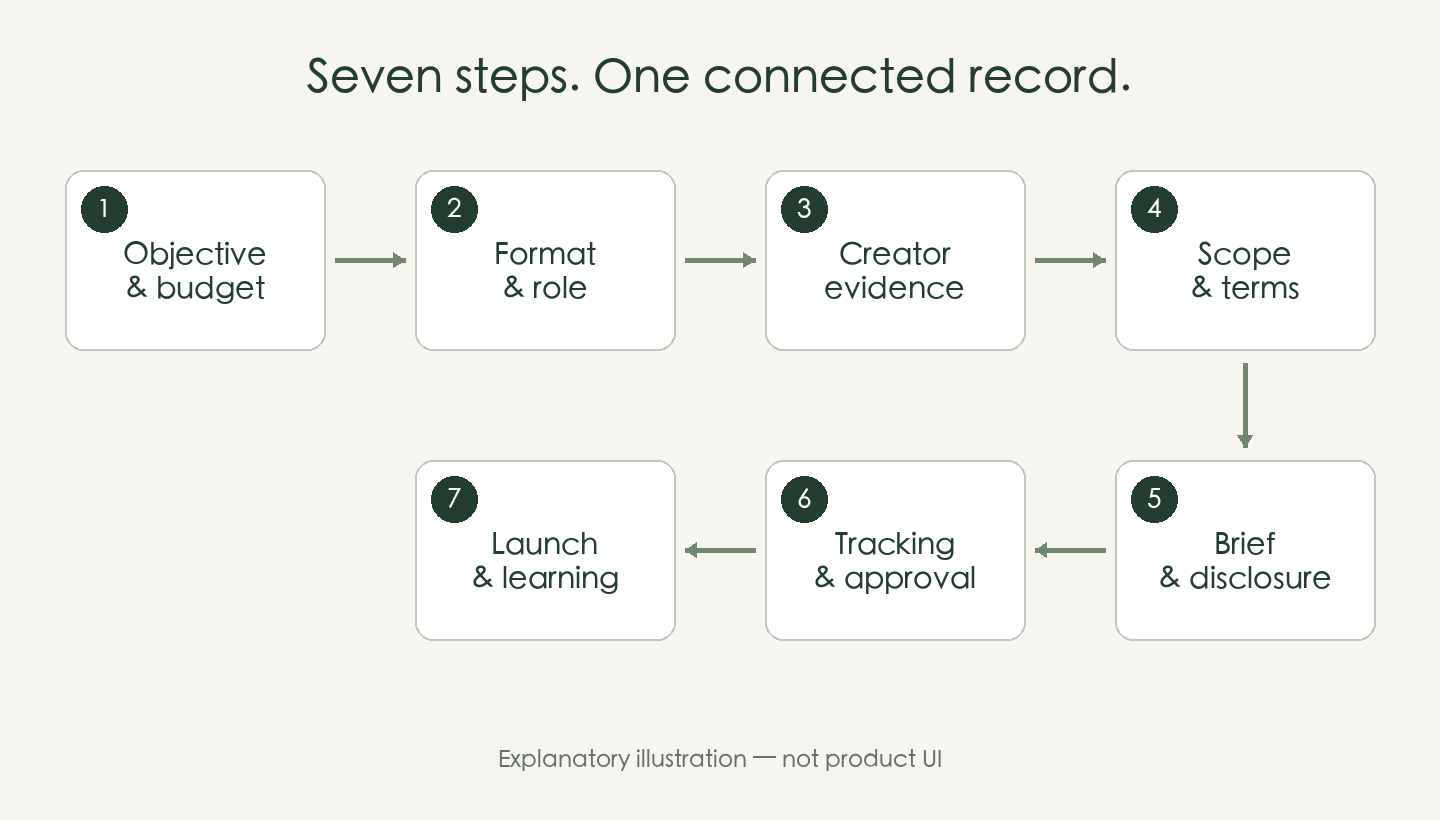



 SEO/GEO
 Learning loop