How to Rank Top Influencers for Your Brand | Tomako
Blog content updates automatically
How to Rank Top Influencers for Your Brand
To rank top influencers for your brand, build a model that explains why one eligible creator should receive priority over another. Define the criteria, assign weights before reviewing scores, calculate a weighted total, and assess the evidence behind each result. Keep missing information, commercial cost, and disqualifying concerns visible rather than burying them in an average.
This guide starts with an existing candidate list. If you need to discover creators, check their basic suitability, and narrow 20 candidates to five, use our guide to choosing influencers. Here, the task is more specific: build a ranking that another person can inspect, challenge, and reproduce.
You will get a weighted scorecard, an Excel formula, a worked comparison, and rules for handling uncertain scores and close results. The model supports a campaign decision; it does not predict a creator’s sales.
Rank creators against one campaign’s requirements.
Define weights and scoring anchors before evaluating candidates.
Keep evidence confidence separate from the fit score.
Treat unresolved essential information as pending.
Test whether reasonable changes reverse the ranking.
Keep the original model when campaign results arrive.
How to rank top influencers for your brand: the model
Can this creator meet the campaign’s essential requirements?
Pass, pending, or fail
Fit
How well does this eligible creator match the campaign?
Weighted score
Decision confidence
How dependable is the evidence, and could uncertainty change the order?
Confidence assessment and next action
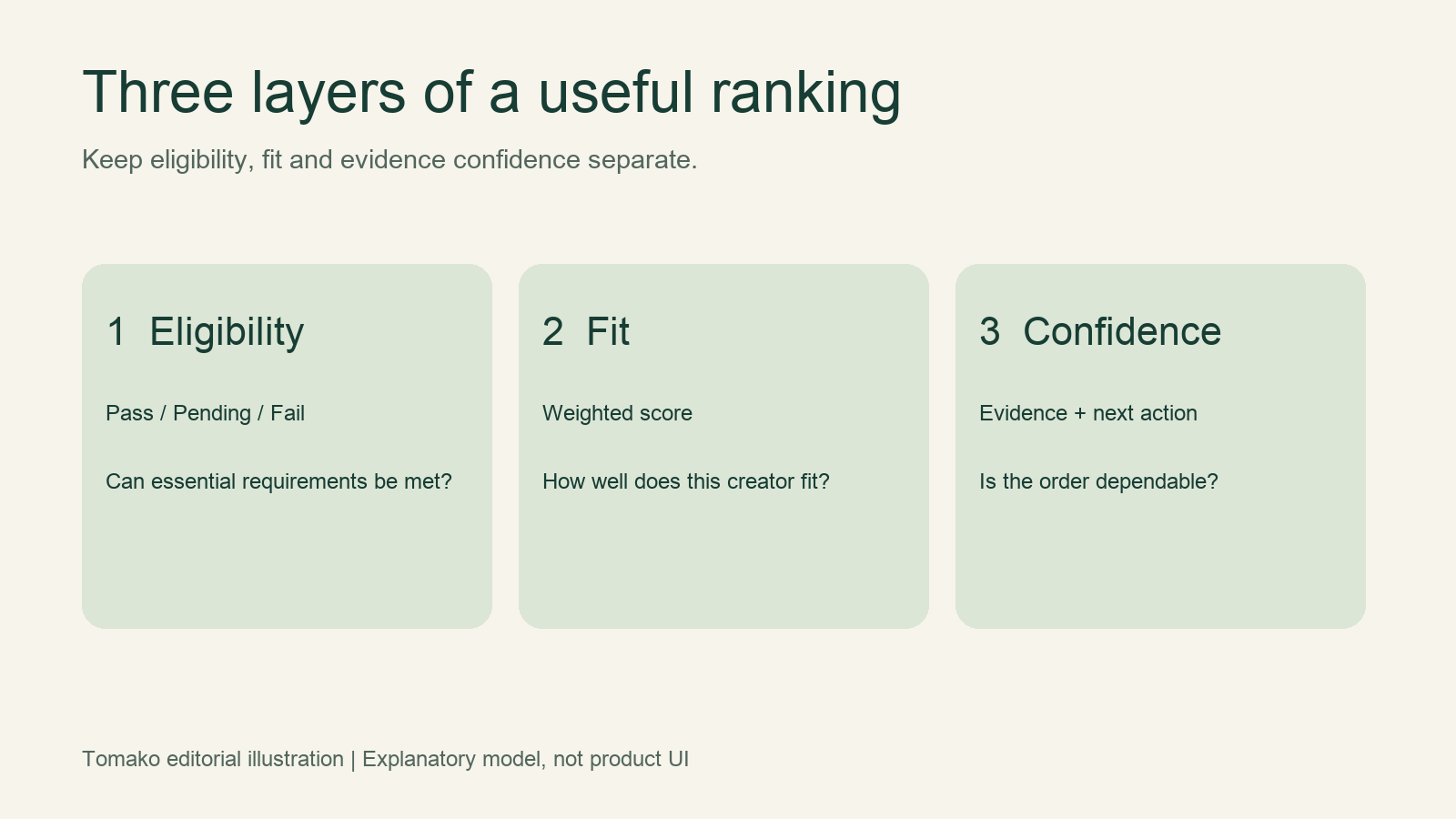
Eligibility is a gate. Fit determines the provisional order. Confidence tells you whether that order is ready to guide a commitment.
For example, an unavailable creator should not win because of excellent audience fit. A creator with missing audience evidence should not receive an average score simply to complete the spreadsheet.
Explanatory illustration: eligibility gates the decision, fit sets the order, and confidence guides the next action.
What you need before scoring
Bring an existing candidate list, a campaign brief, supporting evidence, and comparable deliverable requirements. The brief should specify:
The primary campaign outcome.
The target audience and geography.
The content format.
Essential timing and usage requirements.
The available budget.
If these are unresolved, settle them before choosing weights. Otherwise, the model produces precise answers to an unclear question.
1. Define the criteria and weights
Choose criteria that represent different reasons a creator could succeed. The following model is a starting point for a product demonstration campaign. These weights are editorial recommendations, not industry standards or validated performance forecasts.
Criterion
Weight
Evidence to review
Audience fit
30
Evidence that the audience includes the intended customers
Content and product fit
25
Relevant demonstrations, credible explanations, and natural product use cases
Engagement quality
20
Substantive, relevant responses across the reviewed content sample
Delivery reliability
15
Evidence that the proposed collaboration is achievable and dependable
Commercial fit
10
Workable scope, usage rights, revision allowances, and collaboration terms
Total
100
Keep the absolute price outside the fit score. Commercial fit evaluates the terms of the proposed collaboration; the quote remains a separate cost to compare against the budget.
Avoid rewarding the same advantage repeatedly
Follower count, total views, and total likes can all reward scale. Giving each a large weight may count the same advantage several times.
Choose the measure that serves the campaign. An awareness campaign may prioritize relevant reach; a product demonstration campaign may prioritize audience and content fit. Each criterion should add a distinct reason to prefer a candidate.
Set weights before seeing the totals
Weights should express campaign priorities, not support a preferred creator. If you change the model, rescore every candidate and record why it changed. An 85 in one model is not directly comparable with an 85 in another.
2. Write scoring anchors
Define what each score means before reviewing candidates.
Score
Interpretation
1
Clear evidence of poor fit
2
Some relevant evidence, with substantial weaknesses
3
Adequate fit for the requirement
4
Strong fit supported by specific evidence
5
Particularly strong fit supported by clear, relevant evidence
Pending
Insufficient information to score responsibly
Make the anchors specific to each criterion. For content fit, a 3 might mean the creator covers the right category but offers limited evidence of explaining comparable products. A 5 might require multiple demonstrations that explain use, benefits, and trade-offs.
For delivery reliability, use documented collaboration history and confirmed availability. A new creator without a working history presents an evidence gap, not automatic proof of poor reliability.
Attach a reason to every score
“Content fit: 5. Great creator.” is difficult to review.
A useful note is: “Content fit: 5. Three reviewed demonstrations explain setup, everyday use, and product limitations clearly. Evidence links attached.”
Keep these fields together:
text
Criterion:
Score:
Reason:
Evidence link:
Evidence date:
Important limitation:
Have reviewers score a small shared sample and discuss differences in their interpretations. Calibration should improve the definitions; it should not force agreement where the evidence remains ambiguous.
3. Calculate weighted scores
For a complete scorecard, use:
text
Weighted score = sum of [(criterion score / 5) × criterion weight]
A score of 4 on a criterion weighted at 30 contributes 24 points: 4 ÷ 5 × 30 = 24. With weights totaling 100, the maximum is 100. A score is a fit index, not a percentage chance of success.
Excel setup
Put the five weights in cells D2:H2 as 30, 25, 20, 15, and 10. Put the first creator’s scores in D3:H3.
This formula returns “Pending” if any score is blank or text. Apply data validation to allow only whole numbers from 1 to 5, while allowing blanks for missing evidence. The formula checks completeness; data validation enforces the score range. Some spreadsheet locales require semicolons instead of commas.
Worked example
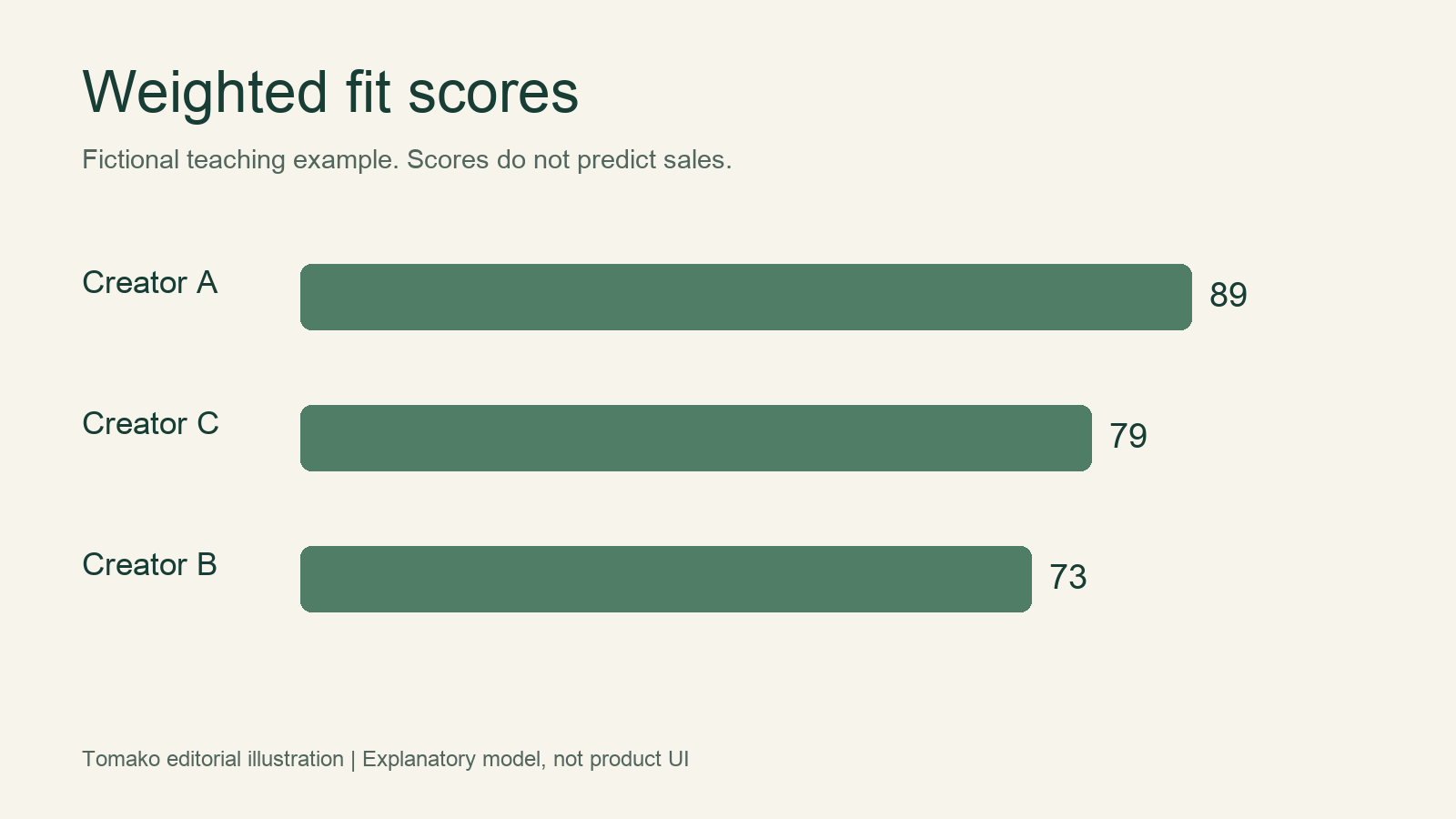
Imagine a campaign for a compact coffee grinder. Three eligible creators are being considered for comparable short product demonstrations. The creator labels, scores, confidence assessments, and quotes below are fictional teaching examples.
Explanatory chart: fictional weighted totals are A 89, C 79, and B 73. Cost and confidence remain separate.
The provisional order is A, C, then B. That does not establish whether A’s premium is worthwhile or whether C’s evidence is dependable enough to commit. Those are separate decisions.
4. Handle missing evidence separately
A high score is useful only when the supporting evidence is adequate. Keep an explicit confidence assessment alongside the fit score.
Do not invent a confidence multiplier and present the resulting number as more scientific. A separate explanation makes uncertainty easier to inspect.
Distinguish missing evidence from imperfect evidence
One documented collaboration plus confirmed availability may support a reliability score with a stated limitation. Unknown audience geography is different when the campaign requires customers in a specific market: that criterion should remain pending.
Do not normalize an incomplete score
A creator scored on four criteria should not be compared with a creator scored on all five by rescaling the subtotal. The missing criterion could change the outcome. Label the subtotal incomplete and exclude it from the final numerical ranking.
Make every gap actionable
Replace “need better data” with a specific request: “Request a recent audience-location breakdown because this campaign serves the United States,” or “Confirm whether the quoted fee includes one revision.”
Prioritize information that could change the decision.
5. Resolve close results with sensitivity checks
A spreadsheet can make small differences look more meaningful than they are. Ask whether a reasonable change in an uncertain input would reverse the order.
Test uncertain scores
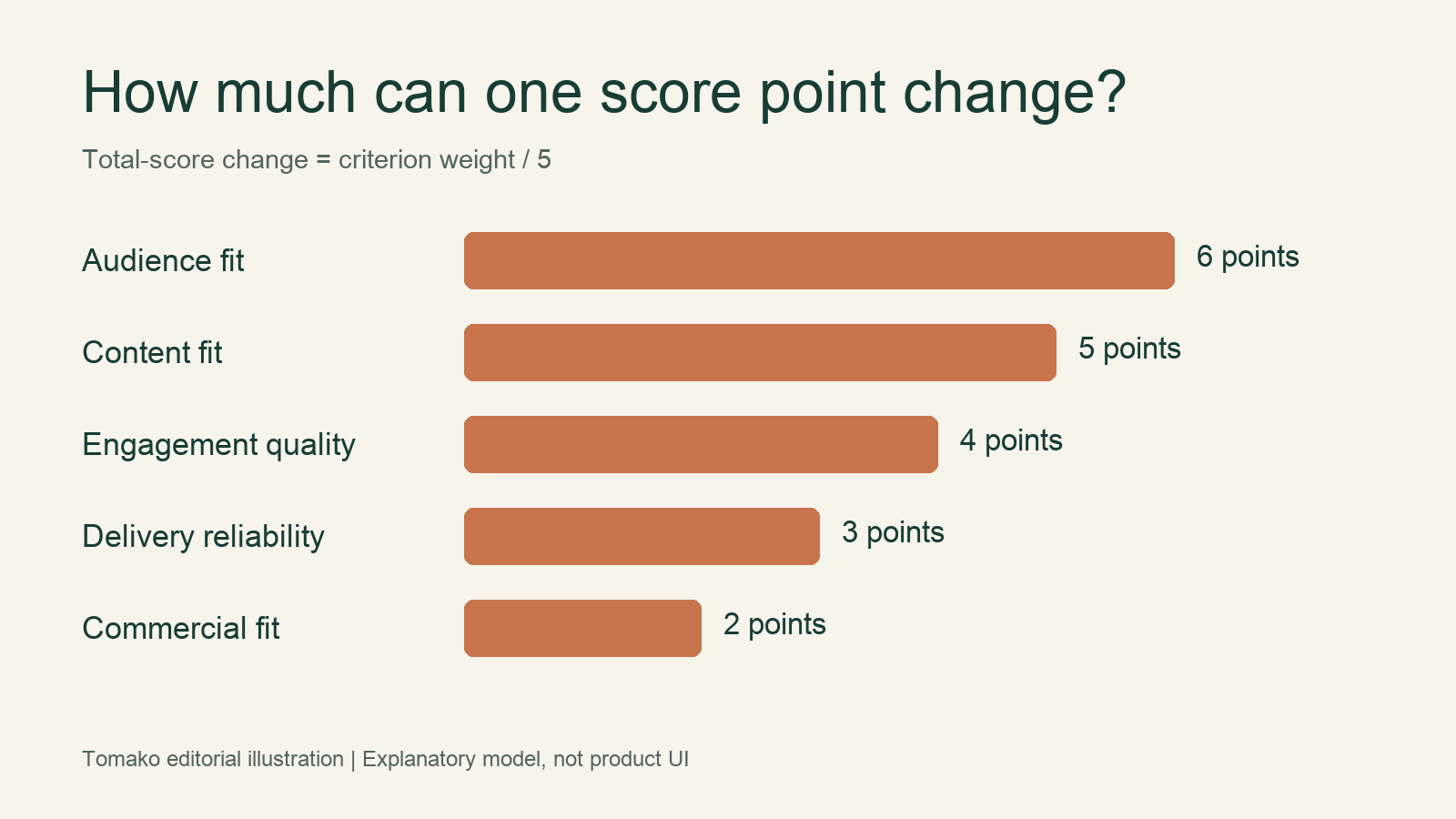
In this model, changing a criterion by one point changes the total by:
Criterion
Effect on total
Audience fit
6 points
Content and product fit
5 points
Engagement quality
4 points
Delivery reliability
3 points
Commercial fit
2 points
Explanatory chart: a one-point change in audience, content, engagement, reliability, or commercial fit changes the total by 6, 5, 4, 3, or 2 points.
Creator C leads Creator B by six points. If further evidence reduces C’s audience-fit score from 4 to 3, that lead disappears. Investigating this uncertainty could matter more than refining a low-weight criterion.
Test plausible alternatives supported by the evidence. Do not manufacture scenarios to make a preferred creator win.
Test a reasonable alternative weighting
If the team is deciding between a consideration campaign and an awareness campaign, create a separate weighting scenario. Keep each scenario’s weights at 100 and recalculate every candidate. If the order changes, explain that the recommendation depends on the campaign goal.
Use a tie-breaking order
Resolve important evidence gaps.
Compare the campaign’s primary criterion.
Compare equivalent costs, deliverables, and rights.
Consider each creator’s role in the campaign.
Use a small pilot when the candidates remain close.
Avoid adding arbitrary decimal places to force a winner. “Two close alternatives with different strengths” can be the most accurate conclusion.
6. Connect the ranking to campaign work
Turn the result into a decision record:
text
Recommended action:
Reason:
Evidence confidence:
Open questions:
Comparable cost:
Decision owner:
Next review:
For the fictional example, A could receive priority for product explanation, C could remain pending a reliability check, and B could be reconsidered for a different campaign brief. Document any override instead of silently changing scores.
Rank before and after outreach
An early ranking helps prioritize contact. A later ranking incorporates confirmed availability, quotes, usage rights, and audience evidence.
Distinguish the research ranking from the ranking based on confirmed responses and terms. After a pilot, add observed delivery and results as another version.
Where Tomako fits
Tomako’s ecommerce workflow page describes brand context, creator discovery, and creator relationship operations among its current foundations, including shortlist, outreach and brief workflows, and performance history.
These functions provide context around a ranking: which creators are being considered, which questions remain open, and how the selected collaboration progresses. Keep the weighted calculation in your spreadsheet unless you have verified an equivalent implementation in your own workflow. The scorecard in this article is an editorial framework, not a documented Tomako ranking algorithm.
If you need to coordinate ongoing creator work, review that workflow against your requirements. For a one-off comparison, a spreadsheet may be sufficient. Check Tomako’s current pricing for the applicable plan and usage terms.
7. Update the model without rewriting history
Save the ranking before a pilot begins. Afterwards, compare the expected strengths with the evidence from content delivery, audience response, and commercial results.
A missed deadline may change the reliability assessment. An unclear demonstration may change content fit. A weak landing page should not automatically lower audience fit. Diagnose the cause before changing the model.
Treat small results cautiously
One post or a handful of orders should not become a permanent verdict. Record the campaign conditions, sample size, and measurement limitations. Look for patterns across comparable campaigns before making broad changes.
Version
New evidence
Decision supported
Research
Initial public evidence
Outreach priority
Confirmed
Availability, terms, and requested evidence
Pilot or collaboration decision
Post-pilot
Observed delivery and measured results
Next campaign decision
The goal is to learn while preserving the assumptions behind earlier decisions.
FAQ
What is the best way to rank influencers for a brand?
Start with eligible candidates, define campaign-specific criteria and weights, and score each creator using comparable evidence. Keep evidence confidence and total cost separate, then check whether uncertainty could change the order.
Should follower count be included in an influencer ranking model?
Include follower count only when it helps explain a campaign-relevant requirement. Avoid giving it a separate heavy weight when other criteria already reward scale, such as total views or total engagement.
How do I handle missing information in an influencer scorecard?
Leave the affected criterion pending when the information is necessary to score it responsibly. Do not substitute an average score or rescale an incomplete total to make it look comparable with a complete assessment.
How do I handle a tie between two creators?
Resolve important evidence gaps first, then compare the campaign’s primary criterion, equivalent commercial packages, and each creator’s role in the campaign. If the candidates remain close, use a small pilot instead of forcing a numerical winner.
Should I rank creators before or after contacting them?
Use a provisional ranking before outreach to prioritize conversations. Update it after creators confirm availability, audience evidence, quotes, and terms, and distinguish that confirmed ranking from the earlier research version.
What if a creator scores high but has a red flag?
A confirmed failure of an essential requirement overrides the score. If the concern is unresolved, mark the creator pending and investigate the specific issue rather than treating the score as approval or assuming misconduct.
Can I reuse the same scorecard for different campaigns?
You can reuse the structure, but review the criteria, weights, and scoring anchors against each campaign’s goal. Scores from different models should not be compared as though they use the same scale.
Can AI rank influencers accurately?
AI can help organize evidence and apply clearly defined rules, but its output depends on the quality and completeness of the inputs. Verify the supporting facts and calculations, preserve missing information, and keep final commercial decisions with an accountable person.
Final recommendation
Learning how to rank top influencers for your brand means building a model that makes the decision visible. Start with eligible candidates, define the weights, attach evidence, keep unknowns pending, test uncertainty, and preserve the original assessment.
Ricky works across influencer marketing, SEO/GEO, and AI-enabled growth workflows, with experience in prompt engineering and development. Her focus goes beyond visibility: connecting research, content production, search presence, and execution into a workflow a team can actually use. On the Tomako Blog, she writes about reusable research methods, content and search strategy, and how AI can help teams move concrete growth work forward.
 Ricky
Ricky