Brand Ambassador: Meaning, Roles, and Brand Partnerships | Tomako
Blog content updates automatically
What Is a Brand Ambassador? A Practical Guide for Brands
A brand ambassador is someone who represents and promotes a brand through an agreed relationship. They might create content, demonstrate products, attend events, make referrals, or answer questions within a relevant community. The role can involve a creator, customer, employee, athlete, or another person whose experience and audience fit the brand.
For a business, the important question is what that person will actually do. Calling someone an ambassador does not define their responsibilities, compensation, exclusivity, or the content you can reuse.
This guide explains how ambassador partnerships work and when they make sense. You will learn how to distinguish the role from influencer and affiliate work, choose a payment structure, set clear expectations, and decide whether a relationship deserves to continue.
Key takeaways
Define the work before choosing the ambassador.
An ambassador can also be an influencer or affiliate.
Repeated representation creates an opportunity for familiarity, not a guarantee of trust or sales.
Agree on deliverables, compensation, usage rights, and review dates before work starts.
Measure delivery and audience response alongside commercial outcomes.
What does a brand ambassador do?
A brand ambassador makes the brand understandable and visible to a relevant audience. The actual work depends on the product, the setting, and the partnership.
A fitness instructor might demonstrate equipment during classes. A food creator might develop recipes using a product. An event ambassador might explain the product to visitors and record their questions. These are different jobs, even if they share the same title.
Turn broad activities into observable responsibilities:
Responsibility
What the work might involve
What to clarify
Product education
Demonstrations, tutorials, and answers to common questions
Supported uses and approved product claims
Content creation
Videos, photos, articles, or social posts
Format, quantity, deadlines, and review process
Community participation
Discussions, events, classes, or meetups
Expected involvement and escalation contacts
Referrals
Sharing a tracked link or offer
Eligibility, attribution, and commission rules
Customer feedback
Recording objections and product-use difficulties
Where feedback goes and who acts on it
Brand representation
Appearances or an ongoing public association
Conduct expectations and competing commitments
A useful brief might say, “Create two demonstrations showing setup and everyday use.” A vague brief says, “Build buzz and be passionate about the brand.” The first gives both sides something they can deliver and review.
Leave room for honest communication. If people repeatedly ask about the same limitation, that is information the brand should address, rather than a problem to script around.
Brand ambassador vs. influencer vs. affiliate
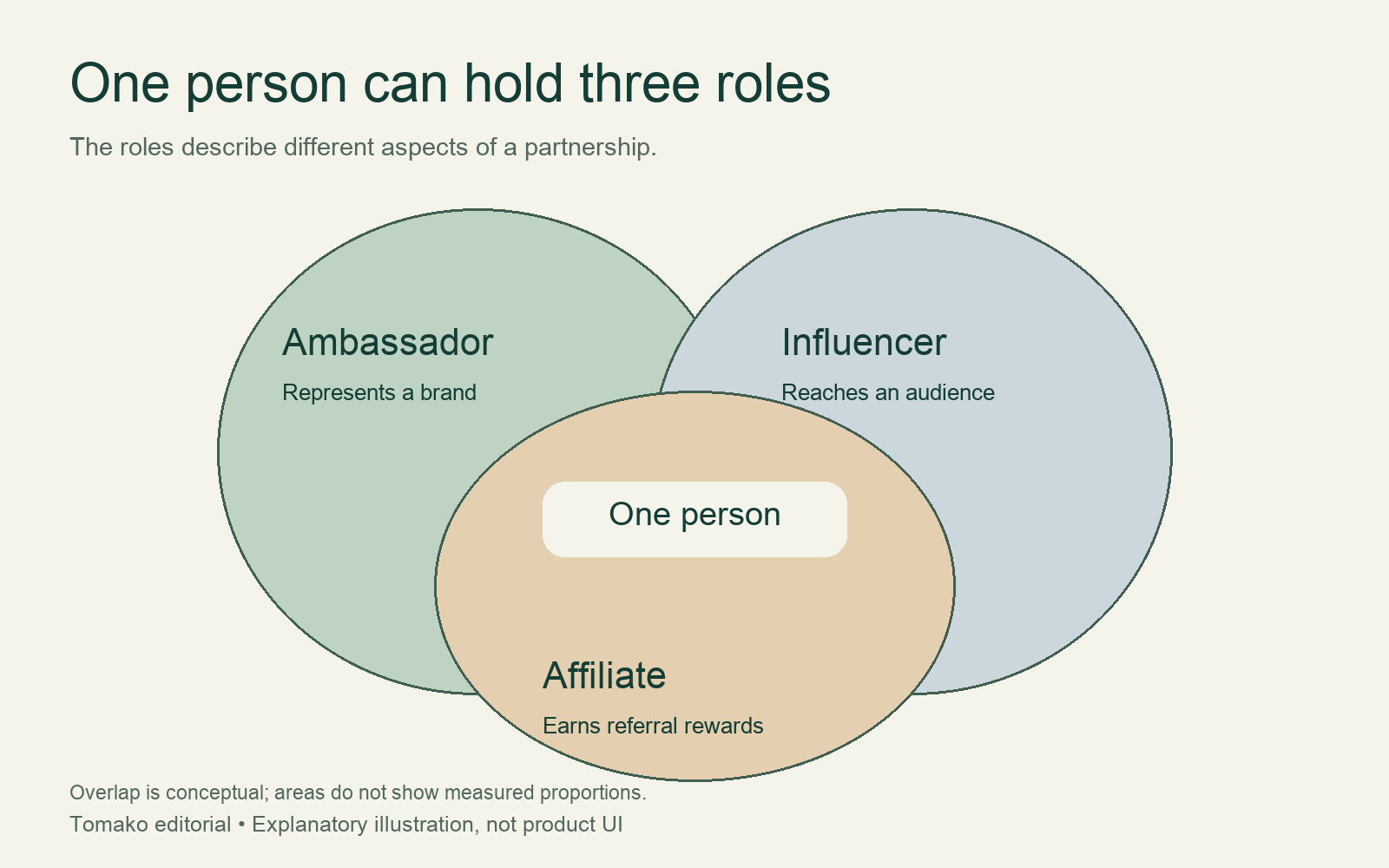
These terms describe different aspects of a relationship. They are not mutually exclusive categories.
An influencer brings an audience or the ability to influence decisions. An affiliate receives compensation under defined referral terms. A brand ambassador represents a brand within an agreed scope, often through repeated activities.
The same person can be all three. A creator might publish regular product tutorials as an ambassador, reach an established audience as an influencer, and earn commissions through an affiliate link.
Dimension
Brand ambassador
Influencer
Affiliate
Main emphasis
Representing a brand
Reaching or influencing an audience
Referring attributable actions
Typical work
Content, appearances, education, or advocacy
Agreed content or campaign activity
Links, recommendations, offers, or referrals
Duration
Defined term or ongoing relationship
One project or an ongoing arrangement
Depends on program terms
Compensation
Fees, products, commission, or a combination
Fees, products, commission, or a combination
Referral compensation under program terms
Exclusivity
Negotiated separately
Negotiated separately
Depends on program terms
What to verify
Responsibilities and depth of involvement
Audience fit and content scope
Tracking, qualification, and payout rules
Avoid treating “ambassador” as a synonym for authentic and “influencer” as a synonym for paid. Both can involve genuine product experience and compensation. An affiliate commission also does not buy scheduled posts unless the agreement says so.
Explanatory illustration: one person can hold all three roles. The overlaps do not represent market shares or measured proportions.
When does a brand ambassador relationship make sense?
An ongoing relationship makes sense when the audience has a reason to hear from the person more than once. A product may take time to use, offer several applications, or support recurring events. The ambassador may also be able to bring useful customer feedback back to the team.
Each appearance should add substance. Repeating the same endorsement is not, by itself, a reason to build a longer partnership.
Before recruiting, answer three questions:
Why should this relationship repeat? Identify a customer question, behavior, or community activity that benefits from continued involvement.
What can this person contribute? Look for relevant experience, access, communication skills, or product knowledge.
Can the team support the relationship? Someone needs to handle samples, questions, approvals, payments, and follow-up.
For a single announcement, a defined campaign may be easier to manage. If the product is still changing, a focused feedback engagement may be more useful than a broad promotional role.
A real example of role fit
The CELSIUS ambassador program describes participants such as fitness enthusiasts, trainers, and athletes. Its public page discusses enthusiasm for the brand, community involvement, and content or communication skills.
That is a more specific picture of fit than follower count alone. The lesson is to connect the role to the community and activities the brand wants to support.
The public page does not establish a universal payment rate or prove that the same program design will work for another business.
How do brand ambassadors get paid?
There is no single payment structure. Compensation depends on the work, time, production requirements, content rights, and restrictions involved.
An employee working scheduled event hours, a creator making tutorials, and an athlete signing an endorsement agreement are different arrangements. A single average payment figure can hide more than it explains.
Structure
What it pays for
What to clarify
Fee per deliverable
A post, video, appearance, or other defined output
Scope, revisions, acceptance, and payment date
Retainer
Recurring work or reserved availability
Included work and the cost of anything extra
Commission
Qualified referrals or sales
Attribution window, returns, exclusions, and payout schedule
Products or perks
Noncash benefits in an agreed exchange
Whether any content is required
Hybrid arrangement
Defined work plus performance incentives
Which payment covers which responsibility
Gifting is not a confirmed content order. If the brand needs a specific post, agree on that obligation before sending a product.
Compare the complete package
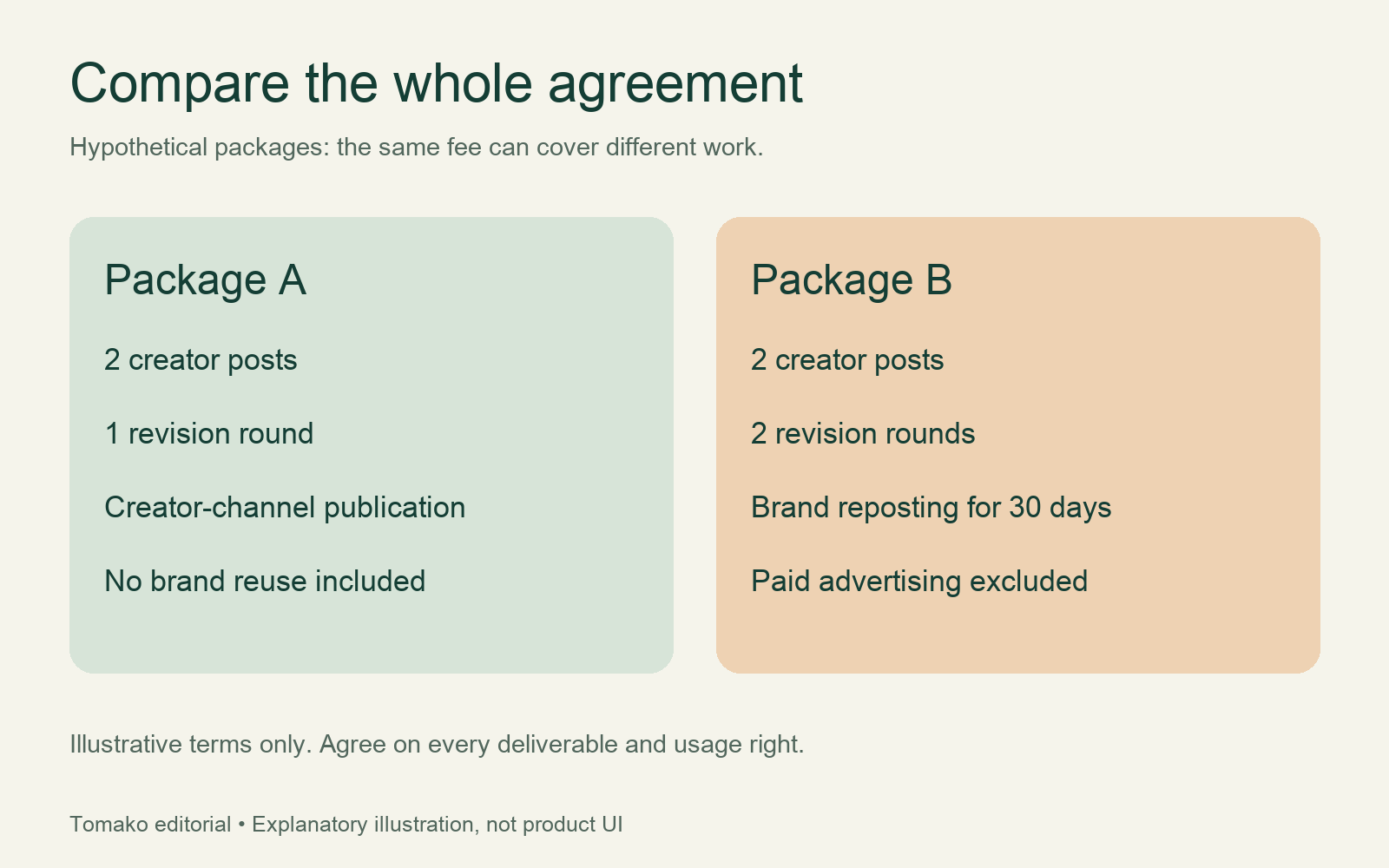
Two creators can quote the same fee for very different work. One package might cover publication on the creator’s account only. Another might include brand reposting, additional edits, or a defined period of paid advertising use.
Compare:
Deliverables and publishing channels.
Production requirements and revision rounds.
Usage rights, duration, editing, and paid distribution.
Exclusivity and other restrictions.
Events, travel, shipping, or other expenses.
Fixed fees and commission obligations.
Internal coordination time.
A lower headline fee does not necessarily produce a lower total cost.
Explanatory comparison: these packages are hypothetical. No market price or standard entitlement is implied; every right must be agreed.
How to build a workable brand ambassador partnership
Start with a limited, clear engagement. An ongoing relationship becomes easier to justify once both sides understand the work and how they collaborate.
1. Write the role before building the list
Use a sentence such as:
We need a person who can help [audience] understand or do [specific task], through [activity], over [defined period].
For a compact coffee grinder, that might mean a home-coffee creator helping first-time customers understand setup and cleaning through practical demonstrations. That role is more useful than “someone with a large following.”
If you need new candidates, use the methods in how to find influencers. Customers and previous collaborators may also be candidates when they have the relevant skills and interest.
2. Check evidence of fit
Look at how the person explains relevant products, responds to questions, and communicates with your target audience.
“Three recent tutorials answer common beginner questions” is usable evidence. “Seems authentic” is an impression that needs more support.
Ask directly about competing commitments and availability. A public profile rarely tells you everything needed to plan the work. For a broader candidate-selection process, see how to choose influencers for your brand.
3. Allow time for product experience
Give the person a realistic opportunity to use the product before asking for an endorsement. Supply setup information, known limitations, approved product facts, and a contact for questions.
If the initial experience produces confusion, use it to improve the brief or reassess fit before increasing content volume. Do not ask the ambassador to describe a positive experience they have not had.
4. Agree on scope and responsibilities
A concise operating summary helps both sides understand the partnership:
Field
Decision to record
Purpose
The customer or business outcome the work should support
Activities
Content, events, referrals, feedback, or other responsibilities
Deliverables
Quantity, format, channel, and timing
Compensation
What is paid, when, and under which conditions
Review
Who reviews what and how many revision rounds are included
Rights
Channels, duration, editing permissions, and paid use
Restrictions
Categories, territories, and competing commitments covered
Measurement
What data will be shared and when
Ownership
One working contact on each side
Review date
When to continue, adjust, or end the relationship
This is an operating summary, not a replacement for an appropriate agreement. Receiving a video file does not automatically give the brand permission to edit it into advertising or keep using it after the agreed term.
5. Make disclosure part of the brief
For endorsements covered by U.S. guidance, the FTC explains that a material connection can include payment, free products, discounts, or an employment relationship. Disclosures should be clear and placed with the endorsement; a vague label such as “ambassador” on its own may not adequately explain the relationship. See the FTC’s Disclosures 101 for Social Media Influencers.
Review the actual publishing format. A disclosure in a caption does not substitute for an appropriate disclosure within a video. Record who checks the disclosure and how corrections will be handled. Apply the requirements relevant to the market in which the endorsement appears.
6. Keep the relationship organized
As more people become involved, small ownership gaps become expensive. A product question waits for an answer, a sample goes to the wrong place, or an approval deadline passes because no one owns the next action.
Tomako’s ecommerce use-case page describes its current foundation around brand context and creator relationship operations: discovery, outreach, briefs, samples, terms, approvals, deliverables, and performance history. Those are relevant areas to evaluate when managing an ongoing collaboration. This is a description of the official product positioning, not a hands-on test of every workflow.
For the coffee example, prepare the product facts, audience description, candidate notes, open questions, and expected deliverables. When assessing the workflow, check whether the shortlist, brief, and next actions stay connected as the relationship progresses.
The potential benefit is continuity. The tradeoff is setup and usage cost. A shared document may be sufficient for one straightforward collaboration. Do not assume an ambassador payroll or commission-payout function from the use-case description.
Before choosing a plan, check Tomako’s current pricing, including the billing period, renewal terms, and how AI points are used. A headline subscription price does not describe the cost of every workflow.
A practical brand ambassador example
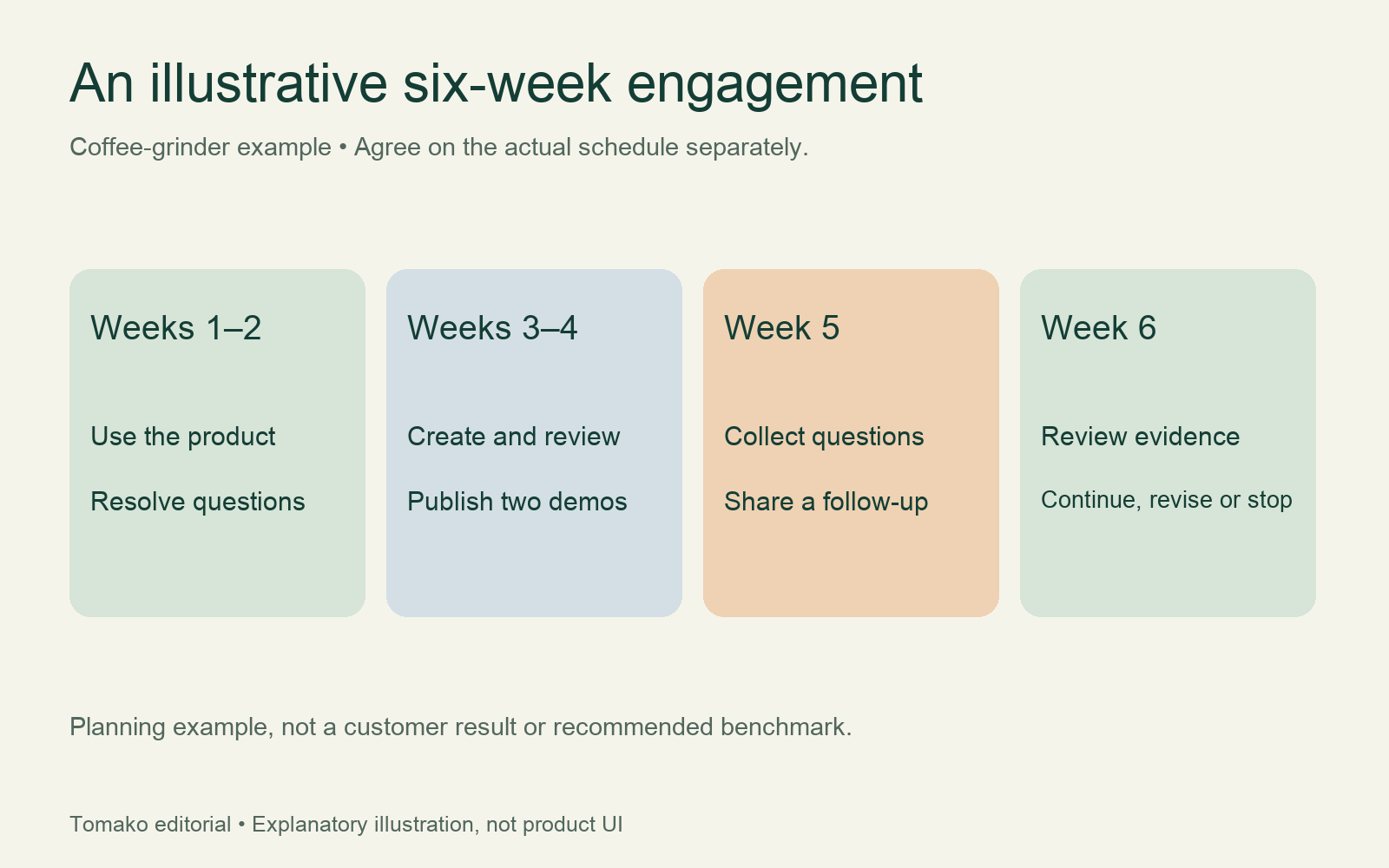
Consider a hypothetical brand selling a compact coffee grinder. It wants to help beginners understand setup and cleaning, and it identifies a creator whose tutorials explain practical details clearly.
Partnership element
Illustrative agreement
Purpose
Explain setup and routine maintenance
Initial period
Six weeks
Product experience
Use the grinder before creating content
Deliverables
Two demonstrations and one audience-question follow-up
Compensation
Negotiated fixed fee; any commission is defined separately
Review
Product accuracy and disclosure
Rights
Specific reposting permission; paid use negotiated separately
Evidence
Published links, agreed metrics, audience questions, and tracked outcomes
Decision
Continue, revise, or stop after review
This is a planning example, not a customer case study or a benchmark. Six weeks is an illustrative period for this specific task; another product may need a different schedule.
Explanatory illustration: one possible schedule for the hypothetical coffee-grinder partnership. Timing and obligations must be agreed for the actual engagement.
Suppose the work arrives on time but viewers still find cleaning confusing. The next action might be to improve the support page and revise the demonstration, rather than recruit more ambassadors.
If the audience is relevant but approvals consume too much time, simplify the review process before renewing. The first engagement should reveal what to improve as well as what to repeat.
How to measure a brand ambassador’s contribution
Decide what evidence you need before the work goes live. A relationship designed to educate customers should not be judged only by discount-code sales.
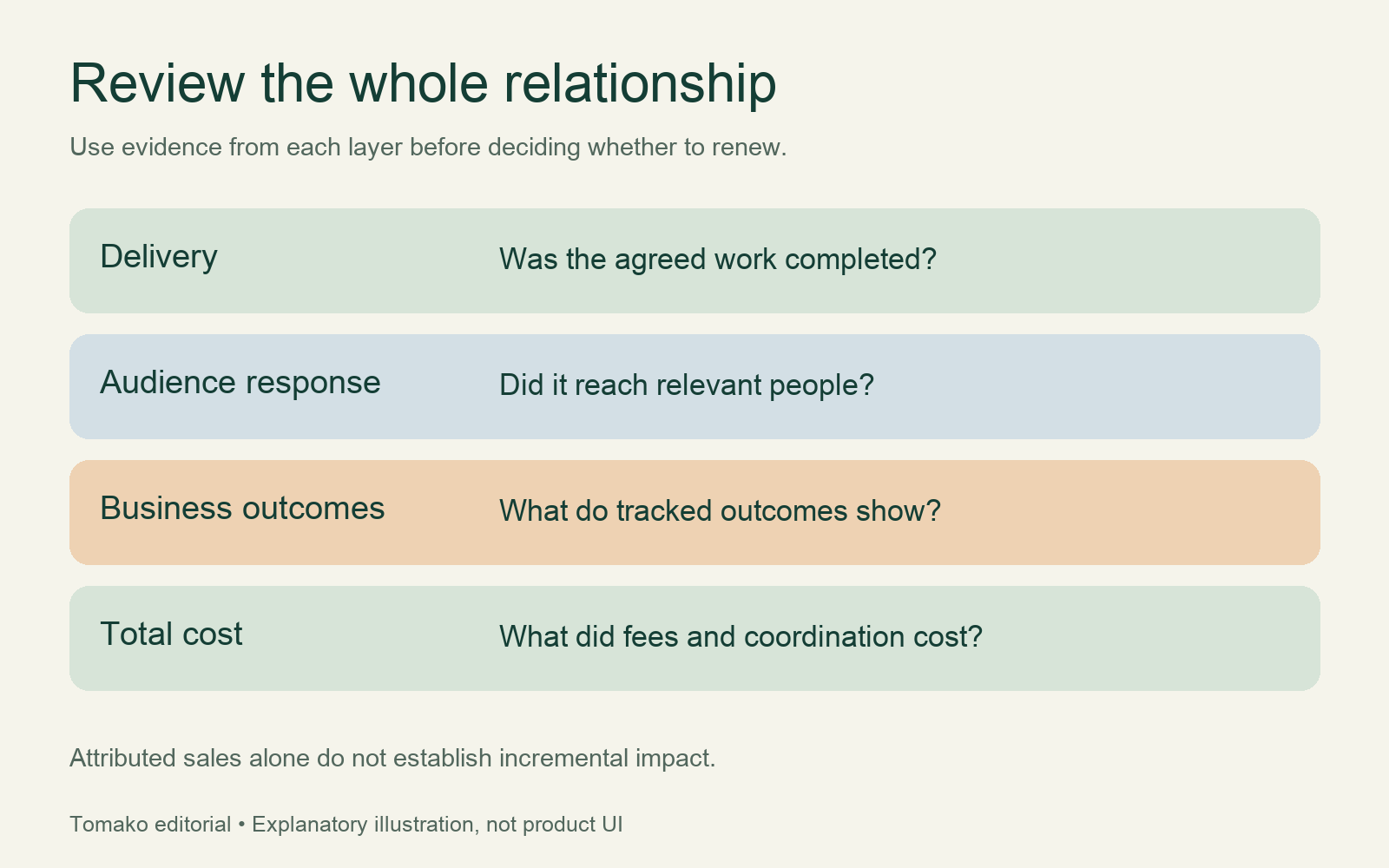
Delivery: did the agreed work happen?
Check whether the content or activity was delivered, whether product information was accurate, whether disclosure was appropriate, and whether agreed audience questions were addressed.
These checks establish whether the relationship is operationally workable before you interpret outcome data.
Audience response: did it reach the right people?
Look for responses relevant to the purpose: qualified views, product questions, site visits, event participation, or other agreed indicators.
Ten specific compatibility questions can be more informative than a large number of generic reactions. Compare similar formats and reporting windows. A post that has been live for one day should not be judged directly against one that has accumulated responses for a month.
Business outcomes: what happened, and what did it cost?
Use available tracking links, codes, and other evidence, while accounting for refunds and discounts.
For a direct-sales objective, estimate contribution from tracked orders after relevant variable costs, then account for the partnership’s cost. Avoid counting the same commission twice.
Attributed sales are not automatically incremental sales. Some customers may already have intended to buy; other purchases influenced by the ambassador may not be tracked. Keep these limitations visible in the renewal decision.
Explanatory checklist: review delivery, audience response, outcomes, and cost together. Attribution alone does not prove incremental impact.
Strong delivery with limited outcome data may justify a more focused test. Poor delivery calls for a different conversation. Separate those situations before deciding whether to renew.
Common mistakes to avoid
Treating the title as the brief
“Brand ambassador” does not specify a schedule, event commitment, or content requirement. Write down the work.
Assuming exclusivity is automatic
Agree on the scope of restrictions and their cost. A broad category restriction can materially change what the person is able to accept elsewhere.
Substituting enthusiasm for evidence
Enthusiasm is useful, but it does not establish product understanding, communication ability, or dependable delivery. Look for evidence of all three.
Renewing without a decision
Set a review date and explain why the relationship should continue. A renewal should have a purpose, scope, and next decision point.
Expanding before fixing the process
Unclear briefs and late payments become harder to manage as the program grows. Fix the operating problems before adding more relationships.
FAQ
What is a brand ambassador?
A brand ambassador is someone who represents and promotes a brand through an agreed relationship. Their work may include content, product demonstrations, events, referrals, or community participation. Responsibilities and compensation depend on the arrangement.
What does a brand ambassador do?
A brand ambassador may explain products, create content, attend events, answer audience questions, make referrals, or provide customer feedback. The brand should define the specific activities and deliverables rather than relying on the title alone.
Do brand ambassadors get paid?
Brand ambassadors may receive fees, products, commissions, other benefits, or a combination. Compensation depends on the work, time, usage rights, restrictions, and agreed terms. There is no single payment model that applies to every ambassador relationship.
What is the difference between a brand ambassador and an influencer?
An influencer brings an audience or the ability to influence decisions. A brand ambassador represents a brand within an agreed scope, often through repeated activities. A person can be both, and either relationship can involve an ongoing paid collaboration.
Can a brand ambassador also be an affiliate?
Yes. An ambassador can earn affiliate commissions while also receiving payment for content or other responsibilities. The agreement should distinguish the work being purchased from the referrals that qualify for commission.
How many followers does a brand ambassador need?
There is no universal follower requirement. A brand may prioritize relevant expertise, community involvement, content quality, or local relationships. Any audience-size requirement should follow from the work the ambassador is expected to perform.
How can someone become a brand ambassador?
Identify brands that fit your experience and audience, review their official program requirements, and show relevant examples of your work. Apply through a verified channel or discuss a clearly defined collaboration. Confirm responsibilities and compensation before accepting.
How should a brand decide whether to renew an ambassador partnership?
Review whether the agreed work was delivered, whether it reached a relevant audience, and what the available outcome evidence shows. Consider total cost, collaboration quality, and unresolved measurement gaps. Renew with a clear purpose and scope rather than continuing automatically.
Final recommendation
A useful brand ambassador relationship starts with a clear role, credible product experience, and an agreement both sides can execute.
Define why the collaboration should repeat. Choose a person who can do the work, make compensation and rights explicit, and review delivery, audience response, and business outcomes together.
Ricky works across influencer marketing, SEO/GEO, and AI-enabled growth workflows, with experience in prompt engineering and development. Her focus goes beyond visibility: connecting research, content production, search presence, and execution into a workflow a team can actually use. On the Tomako Blog, she writes about reusable research methods, content and search strategy, and how AI can help teams move concrete growth work forward.
 Ricky
Ricky