How to Choose an Influencer Database That Saves Time | Tomako
Blog content updates automatically
How to Choose an Influencer Database That Saves Time
A practical buying guide for testing creator coverage, data quality, contact reliability, and workflow before your team commits to an influencer database.
The short answer: choose an influencer database by usable-shortlist yield, not headline profile count. Start with Modash for broad cross-market discovery, HypeAuditor when audience-quality mistakes are costly, Favikon for B2B and LinkedIn research, Influencity when discovery must connect to CRM, or InflDB and FluencerDB for lower-cost seed research.
This guide compares six options, shows exactly how to search in each one, and gives you a 60-minute audit. The winning product is the one that turns a real campaign brief into a small, explainable, contactable shortlist with the least manual rework.
Editorial note: This guide is based on public product pages and industry sources reviewed on August 28, 2026. Vendor database sizes, prices, and feature claims can change. They are attributed to the vendors and are not presented as independently audited results.
Key takeaways
Start with one real campaign brief, not a generic feature checklist.
Distinguish open-web indexes, opt-in marketplaces, and your owned creator CRM.
Measure usable-shortlist yield, freshness, contact reliability, and time to five qualified creators.
Audience fit and creator reputation matter more than raw follower count.
AI search is helpful only when you can inspect and challenge why a creator matched.
Evaluate what happens after discovery; the wrong handoff can erase any time saved by search.
Choose quickly: match the database to the job
If you need broad self-serve discovery across Instagram, TikTok, and YouTube, start with Modash. If the commercial risk is a poor-quality audience, put HypeAuditor first. If you want discovery and creator CRM in one system, test Influencity. For B2B or LinkedIn-heavy searches, include Favikon. Use InflDB or FluencerDB only as lower-cost first passes when your team can manually verify every shortlisted profile.
The real test is not the headline database size. It is whether one live brief produces five relevant, current, contactable creators in under an hour—and whether the reason for choosing each creator survives into outreach.
If you need discovery, outreach, campaign operations, and reporting in one buying decision, compare the eight influencer marketing platforms. If audience authenticity is the main risk, keep the manual fake-influencer audit beside the database during your trial.
Influencer database tools compared
The figures below come from current public vendor pages. Treat them as claims to verify during your trial, not as independent rankings.
Best for: Brands that need broad discovery across Instagram, TikTok, and YouTube.
How to find creators: Set the platform and target market first, then layer creator size, niche keywords, recent activity, audience location, engagement, and prior brand collaborations. Review the first 20 results before opening more profiles; the useful output is a short list with reasons, not the largest export.
Pros: Modash explains its open-network data model, offers detailed creator and audience filters, and connects discovery with outreach. Its documentation says public creator information is collected several times a month.
Cons: Its highlighted coverage centers on three platforms. Teams needing LinkedIn, Twitch, or other networks should verify coverage. Its breadth may exceed occasional discovery needs.
Ideal use case: A consumer brand running repeated micro-influencer searches across several countries.
HypeAuditor
Best for: Teams that put audience vetting and account analysis ahead of raw outreach volume.
How to find creators: Search from the campaign topic and target audience, then narrow by geography, creator tier, audience demographics, growth patterns, and account-quality signals. Use the score to decide what to inspect—not as an automatic approval.
Pros: The product emphasizes discovery, audience-quality analysis, authenticity checks, flexible filters, and multi-platform coverage.
Cons: Public pricing was not disclosed on the reviewed page. Buyers need a quote and should check report limits; small teams may not need the full analytics stack.
Ideal use case: An agency that must defend creator recommendations to clients with structured audience evidence.
Influencity
Best for: Teams that want discovery and an owned creator relationship system in one suite.
How to find creators: Build filters from the live brief, save qualified profiles into the relationship layer, and immediately record segment, owner, selection reason, contact status, and campaign history. Its value depends on whether the saved record replaces a separate spreadsheet.
Pros: Influencity distinguishes its open-market index from opt-in networks and connects profiles with audience data, relationship history, outreach, and campaigns.
Cons: Verify pricing, platform-level data depth, and measured versus estimated metrics. Discovery-only teams should test whether the wider suite adds value.
Ideal use case: An in-house program that wants to preserve notes, history, segmentation, and repeat partnerships.
Favikon
Best for: B2B teams and marketers who need LinkedIn creator discovery alongside consumer platforms.
How to find creators: Write the category problem in natural language, include LinkedIn or another required network, then inspect whether recent posts show genuine subject expertise. For B2B, weigh repeat topic depth and audience role more heavily than follower count.
Pros: Favikon highlights natural-language search and nine platforms, including LinkedIn—useful when a brief does not fit the standard consumer-social trio.
Cons: Its advertised index is smaller than the largest open-web databases. Test niche depth and inspect authenticity and pricing estimates.
Ideal use case: A SaaS team searching for credible operators, educators, and category voices on LinkedIn and YouTube.
InflDB
Best for: Small teams that want an inexpensive way to explore creators and public contact data.
How to find creators: Start with country, topic, platform, and follower range, export only plausible matches, then manually verify content recency, audience fit, and every contact path before outreach.
Pros: The reviewed page lists a low public price, broad platform coverage, topic and location filters, and email export.
Cons: The public page gives less detail about audience methodology, contact verification, and workflow depth. Verify those areas in the demo.
Ideal use case: A small campaign where the team can perform its own manual vetting after initial discovery.
FluencerDB
Best for: A free first pass before paying for a larger platform.
How to find creators: Use niche terms to create a seed list, open the source accounts, and treat every result as unverified until you confirm activity, content fit, market, and contactability yourself.
Pros: It offers a simple search experience and publishes an update-frequency claim.
Cons: The reviewed page gives limited detail about platforms, audience methodology, contacts, and campaign workflow. Treat it as a discovery aid until verified.
Ideal use case: Generating seed creators or testing whether a niche has enough discoverable profiles.
A practical audit: test any database in 60 minutes
Do not run six different searches and compare whichever screenshots look best. Use the same brief, the same scoring rules, and the same sample size.
Step 1: Write a search brief that can fail
Use constraints precise enough to reveal weakness. For example:
Find US-based YouTube or TikTok creators who regularly explain AI productivity tools to founders, have 10,000–150,000 followers, posted in the last 30 days, and reach an English-speaking small-business audience.
Include platform, market, language, creator size, content theme, audience, recency, and a reason the creator fits the campaign.
Step 2: Review the first 20 results
For each result, record a simple pass or fail for:
correct market and language;
relevant recent content;
appropriate creator size;
plausible audience fit;
active account;
contact path available;
no obvious brand-safety mismatch.
Do not change the rules halfway through because one platform returns fewer results.
If 6 of the first 20 results are suitable, the yield is 30%. This is not a universal quality benchmark; it is a comparable result for your exact brief.
Step 4: Verify five records manually
Open the source profiles and check recent activity, follower or subscriber count, bio, content topic, public contact details, and any audience fields you can reasonably validate.
Record errors without turning one mismatch into a sweeping conclusion. A five-profile sample is an early warning system, not a statistical audit of the whole database.
Step 5: Test the handoff
Save five creators. Share the list with a colleague. Add a reason for selection, an owner, a note, and a next action. Then see whether you can prepare outreach or export the context without rebuilding it.
Measure the time from entering the brief to producing five contact-ready candidates.
Keep the worksheet. When a sales demo makes a new promise, add a test instead of adding another adjective to your comparison notes.
How AI is changing creator discovery
AI can make database search more natural. Instead of stacking 15 filters, a marketer can describe a creator in plain language, search captions or visual themes, summarize profiles, and find lookalikes.
That improves speed, but it also introduces a new question: why did this creator match?
I would look for an explanation that connects the result to observable evidence—recent content, audience location, topic consistency, performance pattern, or past partnerships. If a system only returns an opaque fit score, the human reviewer still has to reverse-engineer the recommendation.
The IAB reported that three in four brands were using or planning to use AI for creator-marketing tasks, while 95% of advertisers expressed concerns about AI in creator marketing. The lesson is not to avoid AI. It is to use AI for search compression and evidence gathering while keeping human approval for reputation, brand safety, commercial terms, creative judgment, disclosure, and rights.
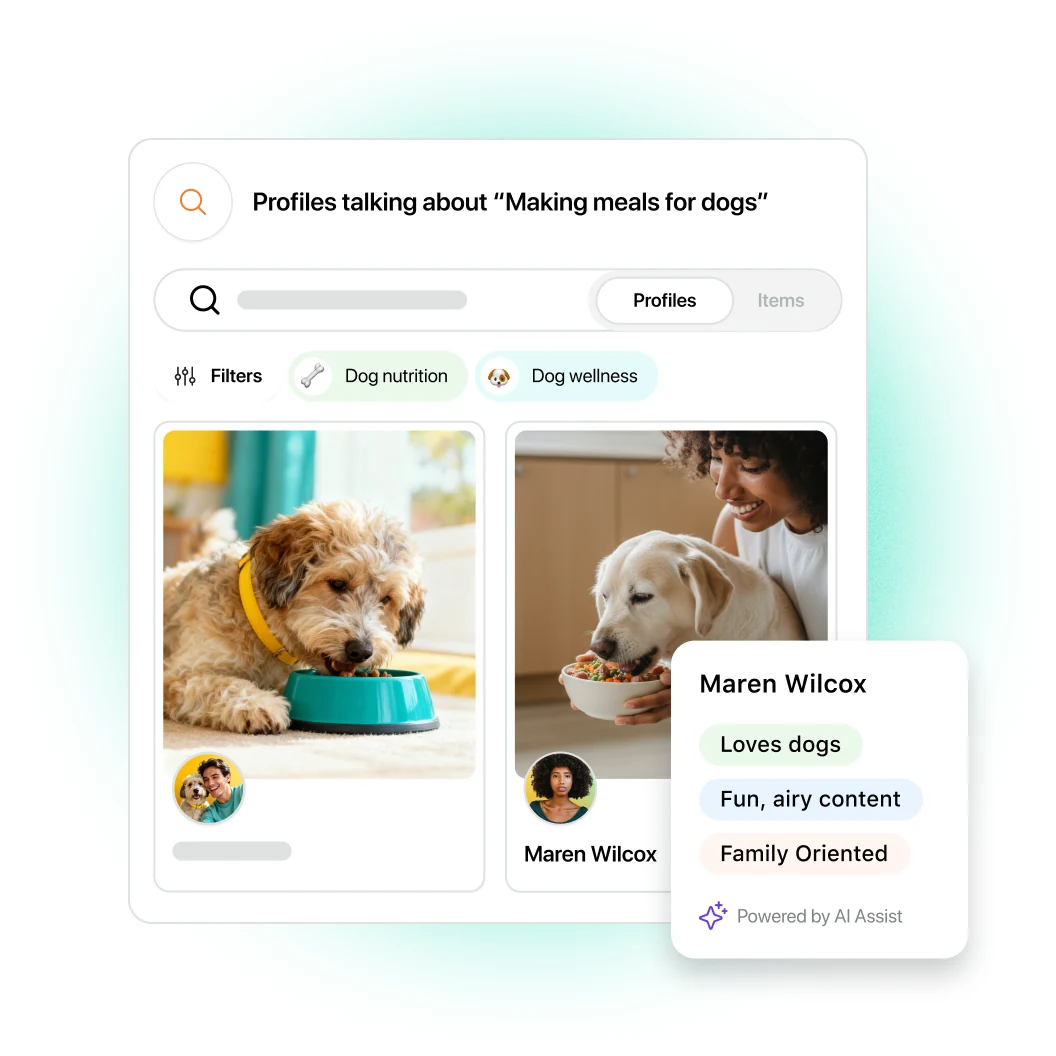
Source: Sprout Social's public creator-discovery page, captured September 1, 2026. It is a concrete example of topic-led discovery outside the six databases above; the vendor image does not independently prove match quality.
Where Tomako fits in the workflow
Tomako should not be described as the largest influencer database because its current public pages do not document a searchable index size. They also do not publicly substantiate a dedicated fake-follower score or a complete audience-analysis product.
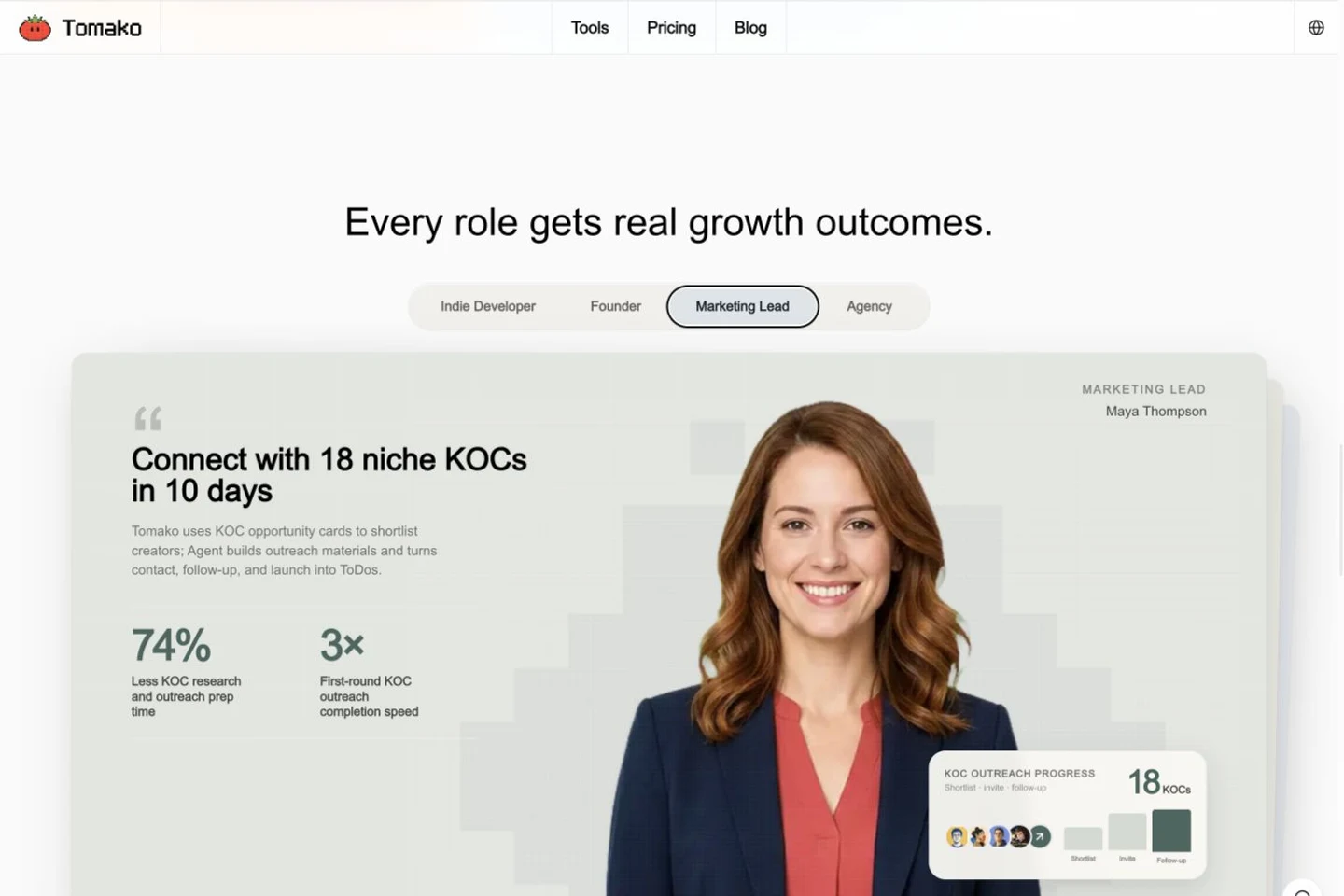
Its documented role is different. Tomako surfaces creator leads and KOC opportunity cards, helps teams build KOL/KOC shortlists, prepares outreach materials, and turns contact, follow-up, and launch work into ToDos. It connects that creator work with broader content, SEO, community, feedback, and competitive-marketing context.
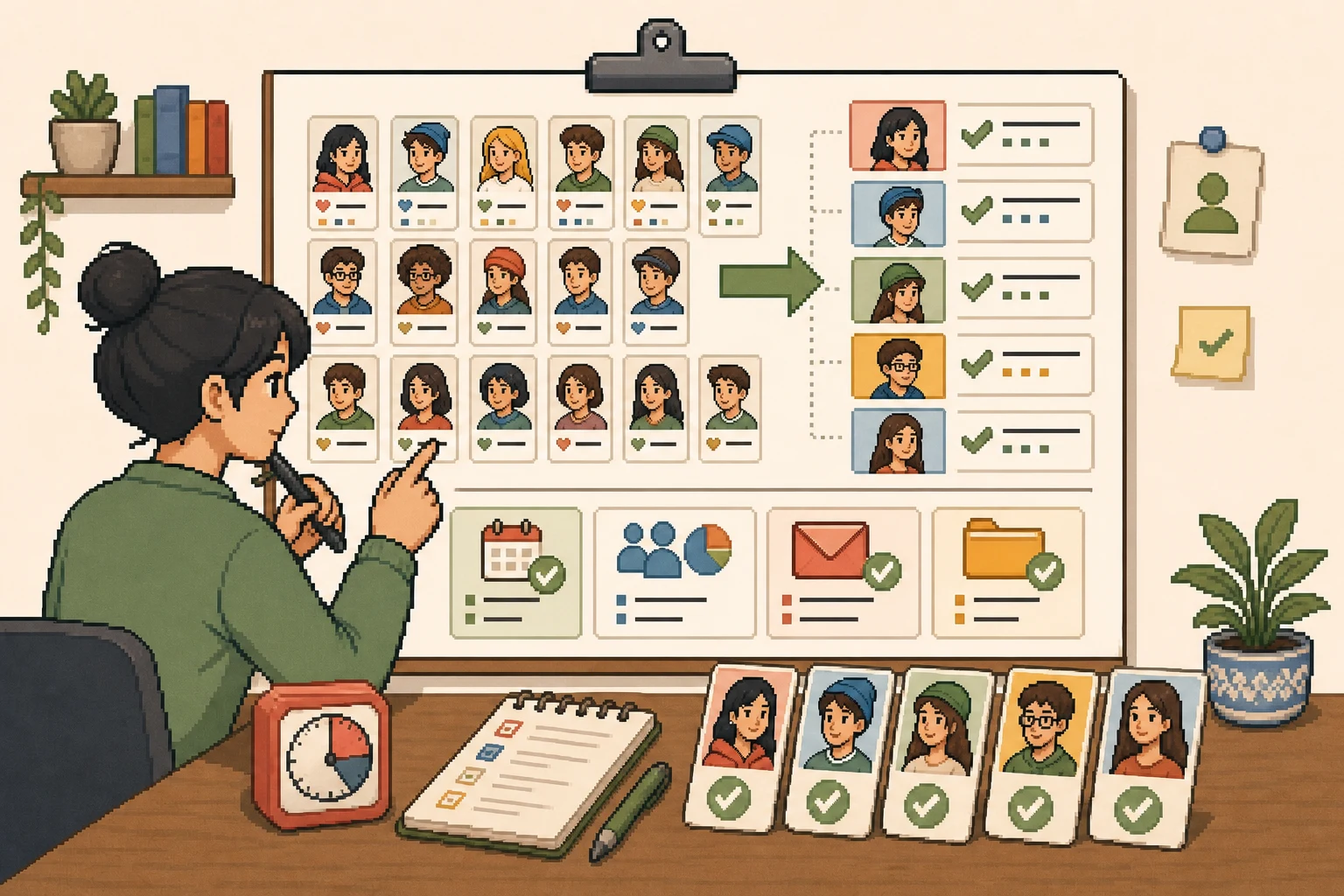
Source: Tomako's public product page, captured August 28, 2026. The image demonstrates the intended KOC workflow. The example identity and performance figures are demo content, not independently audited campaign results.
That makes Tomako relevant when the bottleneck is not merely finding names, but deciding which creator opportunities deserve action and keeping the follow-up moving. If your first requirement is a disclosed index with hundreds of millions of profiles and deep audience reports, evaluate a specialist database first. If your problem is turning creator research into coordinated growth work, see how Tomako approaches an always-on marketing workflow and compare current Tomako plans.
Common buying mistakes
Buying the largest number
A giant index improves potential coverage. It does not prove relevance, freshness, contact quality, or activation. Always pair the size claim with your usable-shortlist yield.
Testing with an easy query
“Fitness influencers in the US” lets every demo look good. Use a real brief with platform, audience, content, recency, and commercial constraints.
Treating estimated data as observed truth
Audience demographics, authenticity, reach, and rates are often estimates. Ask for methodology and uncertainty, then review important creators manually.
Ignoring the creator's content
Filters can narrow a list, but they cannot replace reading and watching recent work. A creator may match a category label and still have the wrong tone, format, sponsorship density, or audience relationship.
Forgetting the post-search workflow
If every good result must be copied into a spreadsheet, enriched elsewhere, emailed from another tool, and measured in a third system, calculate that labor before choosing the cheaper plan.
Locking into an annual plan after one demo
Run the 60-minute audit, review limits in writing, and test at least one difficult brief. Confirm seats, credits, exports, support, renewal terms, and data access after cancellation.
When a free database is enough
A free tool can be enough when you run occasional campaigns, work in a broad niche, and are willing to verify every candidate manually. Native platform search, creator marketplaces, public directories, and a well-maintained spreadsheet may cover an early program.
A paid database becomes more useful when you repeatedly need cross-market discovery, audience filtering, contact access, team collaboration, data refreshes, or campaign history. The trigger is not “we are a serious brand.” It is that manual research and fragmented handoffs now cost more than the system would save.
Frequently asked questions
What is an influencer database?
An influencer database is a searchable collection of creator profiles used to discover, evaluate, contact, and sometimes manage influencers. Depending on the product, it may index public profiles, include opt-in creators, or store a brand's own creator relationships and campaign history.
What is the difference between an influencer database and a creator marketplace?
An open database can index creators who have not joined the product. A marketplace usually includes creators who opted in and are open to opportunities. Databases tend to offer broader discovery; marketplaces can make activation easier but may provide a smaller pool.
Is there a free influencer database?
Yes, but free tools usually limit filters, reports, contacts, exports, or usage. They can work for seed research and small campaigns if you manually verify every shortlisted creator. Test data freshness and contact provenance before relying on a free result.
How big should an influencer database be?
There is no universal minimum. It must be large enough to cover your markets, platforms, niches, and creator tiers. Measure how many qualified creators appear for a real brief rather than comparing headline profile counts alone.
How do influencer databases find contact information?
Methods vary. A tool may display public business contacts, use information supplied by opt-in creators, or add enrichment. Ask for the source, date, verification method, and applicable usage restrictions. Do not assume every displayed address is current or appropriate for outreach.
Can AI choose the right influencer automatically?
AI can narrow results, analyze public signals, summarize content, and explain possible matches. A person should still approve audience fit, reputation, brand safety, creative quality, terms, disclosure requirements, and content rights.
Final recommendation
The best influencer database is not the one that lets you search the most profiles. It is the one that repeatedly turns your campaign brief into a small, defensible, contact-ready shortlist with less manual rework.
Run the same 60-minute audit in every trial. Compare usable-shortlist yield, freshness, contact reliability, time to five qualified creators, and what survives the handoff into outreach. Those numbers will tell you more than a vendor's homepage counter.
If you already have creator leads but struggle to convert them into shortlists, outreach preparation, and consistent follow-up, explore how Tomako turns creator opportunities into actionable marketing work. Use a specialist database when you need broad indexed discovery; use an execution layer when the real constraint is getting the work finished.
Ricky works across influencer marketing, SEO/GEO, and AI-enabled growth workflows, with experience in prompt engineering and development. Her focus goes beyond visibility: connecting research, content production, search presence, and execution into a workflow a team can actually use. On the Tomako Blog, she writes about reusable research methods, content and search strategy, and how AI can help teams move concrete growth work forward.
 Ricky
Ricky