I have seen creator reports celebrate millions of views, thousands of comments, and a “4× return”—then fall apart as soon as someone asks whether the campaign actually made money.
The problem is rarely arithmetic. It is definition. Revenue is called profit, free products disappear from the cost line, discount-code sales are treated as the entire customer journey, and earned media value is added to cash revenue as if both were equally certain.
This guide gives you a more defensible way to measure influencer marketing ROI. You will get a profit-first formula, a complete cost checklist, a practical attribution ladder, a worked campaign example, and a reporting format that separates observed results from estimates.
Key takeaways
ROI should use profit or contribution, not revenue alone.
A campaign can show 4× ROAS and still lose money.
Total cost includes more than creator fees: product, shipping, commission, labor, licensing, software, and amplification can all matter.
Direct attribution is a floor, not automatically the whole answer.
Awareness, content value, and assisted conversions should be reported separately unless the valuation method is documented.
There is no universal “good ROI.” Your break-even point depends on margin, customer value, attribution rules, and what the budget could earn elsewhere.
For a sales-focused creator campaign, I use this formula:
Influencer marketing ROI (%) = ((attributed revenue × gross margin) − total campaign cost) ÷ total campaign cost × 100
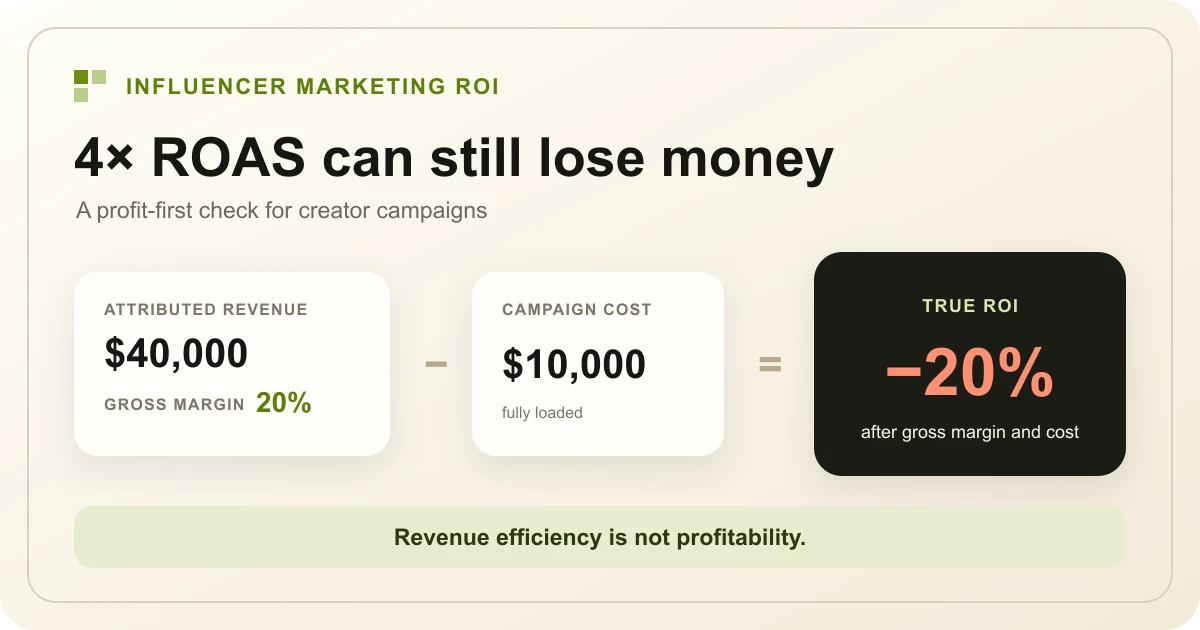
This version is more useful than the popular revenue-minus-cost formula because it accounts for the cost of the products sold. If a campaign generates $40,000 in attributed revenue but those sales carry only a 20% gross margin, the campaign generated $8,000 in gross profit before campaign costs—not $40,000 in return.
The formula is still only as credible as its inputs. You need to define:
Which revenue the campaign can reasonably claim.
Which gross margin applies to the products actually sold.
Which costs belong in the campaign.
Which attribution model and lookback window you used.
Which outcomes are observed and which are modeled.
The formula is simple; attribution and cost discipline make it believable.
Measure one campaign from setup to decision
If you only use one part of this guide, use this workflow. It follows the order in which the work should happen—not the order in which metrics happen to appear in a dashboard.
Step 1: decide what the campaign must prove
Write one decision at the top of the measurement sheet:
Renew this creator.
Increase the budget for this creator group.
License and amplify one asset.
Change the offer or landing page.
Stop because the economics do not work.
Then choose one primary campaign job: direct sales, leads, awareness, reusable content, or relationship learning. A sales campaign can still produce awareness, but awareness should not quietly become cash in the ROI numerator.
Step 2: build the cost sheet before content goes live
Create one row for every cost you can defend: creator fee, commission, seeded product at cost, shipping, internal labor, agency fee, software allocation, rights, editing, localization, paid amplification, and discount impact.
Cost field
Amount
Evidence
Owner
Final?
Creator fee
Contract or invoice
Partnerships
No
Product and shipping
Fulfillment record
Operations
No
Internal labor
Hours × loaded rate
Campaign lead
No
Usage rights and amplification
Contract + media spend
Paid social
No
Software and agency allocation
Invoice or allocation rule
Finance
No
Do not use retail price for seeded product unless that is the accounting rule finance has approved. Do not count product cost twice when gross margin already captures the cost of goods on units sold.
Source: Sprout Social's official Campaigns page, reviewed September 1, 2026. The vendor image shows campaign content and fee records in one workflow; it does not prove financial ROI or replace finance data.
The screenshot illustrates the useful operating idea: keep the approved content and cost record close together. Whether you use Sprout, Shopify Collabs, a spreadsheet, or another platform, your ROI calculation still needs complete costs and an agreed margin.
Step 3: give every creator a tracking package
Create the package before outreach or contracting, not after the post goes live:
A creator-specific UTM link and landing page where practical.
A unique code or affiliate ID when the offer supports it.
A post-purchase survey option using the creator's recognizable name.
A row in the campaign record for publish date, platform, deliverable, fee, rights, and tracking IDs.
A declared lookback window that fits the buying cycle.
Use a naming convention that can be reconciled across the social platform, analytics, commerce, affiliate, CRM, and finance records. creatorname_platform_campaign_date is more useful than influencer_01.
Step 4: collect four evidence buckets
Do not force one tool to tell the whole story. Reconcile:
Evidence bucket
Examples
Confidence
Direct
Creator link, code, affiliate sale, creator landing page
Highest, but incomplete
Assisted
Analytics path, CRM note, platform engagement followed by a conversion
Useful supporting evidence
Self-reported
Post-purchase survey, sales-call note
Valuable but subject to recall
Modeled
Holdout, geo-lift, brand-lift, causal model
Potentially powerful; assumption-sensitive
Deduplicate the same order or lead before adding totals. If a purchase used a creator code and also appears in a UTM report, it is one conversion, not two.
Step 5: calculate gross profit, then ROI
For sales campaigns:
Add attributed revenue under the agreed attribution rule.
Multiply by the actual gross margin of the products sold.
Subtract the complete campaign cost.
Divide the net contribution by campaign cost.
Multiply by 100.
Also calculate the break-even revenue before launch:
Break-even attributed revenue = total campaign cost ÷ gross margin
The worked example below shows why this matters: a campaign can display 4× revenue-to-spend and still produce negative ROI.
Step 6: report a floor, a base case, and an upper scenario
Floor: directly observed gross profit only.
Base case: direct plus corroborated assisted return under a stated model.
Upper scenario: modeled incremental or longer-term value with assumptions.
Do not add all three together. They overlap. Put the attribution window, margin, cost rule, and excluded data beside the result.
Step 7: end with an action
A useful ROI report ends with a decision, not a chart collection. State what changes next: creator, offer, creative, landing page, tracking, rights, budget, or channel. If no metric can change a decision, the report is too broad.
Quick pre-launch checklist
One primary campaign job and one decision
Complete cost sheet and product margin
Creator-level UTM, code or other direct identifier
Post-purchase or sales self-report field
Attribution window and deduplication rule
Floor/base/upper reporting format
Why influencer marketing ROI is under more scrutiny
Creator marketing is large enough that measurement can no longer be an afterthought. The IAB projected US creator ad spend at $37 billion in 2025, up 26% year over year. Nearly half of creator ad buyers—48%—called creators a “must buy.”
The same IAB research found that 40% of buyers ranked overall ROI among their top creator-campaign KPIs. That creates an uncomfortable mismatch: the most common creator goals include awareness, reach, and trust, while the most requested executive metric is a financial return.
A narrower EMARKETER forecast, covering payments to US creators for social and video promotion while excluding paid media, put 2025 spending at $10.52 billion and annual growth at 15%.
These totals differ because they measure different parts of the creator economy. That is precisely the lesson for campaign reporting: before comparing two ROI numbers, confirm that they count the same return, costs, period, and media activity.
The HubSpot 2026 State of Marketing survey also shows why simple influencer-tier rules are weak. Among more than 1,500 marketers surveyed, 32.4% reported the most success with micro-influencers, while 30.2% selected macro-influencers. The small gap is a reminder that creator size alone does not determine return.
ROI, ROAS, contribution, and EMV are not interchangeable
I would not approve an influencer report until every headline number has the correct label. These metrics answer different questions.
Metric
Basic calculation
Best used for
Main limitation
ROI
(Profit − total cost) ÷ total cost
Profitability
Requires margin and complete costs
ROAS
Attributed revenue ÷ ad spend
Revenue efficiency
Ignores margin and non-ad costs
Contribution
Attributed gross profit − campaign cost
Cash contribution
Harder to compare across budgets
CPA
Campaign cost ÷ acquired customers
Acquisition efficiency
Needs a reliable customer count
EMV
Estimated media equivalent
Exposure comparison
It is not observed revenue
Brand lift
Test-group change vs. control
Awareness or consideration
Requires research design and scale
ROI answers a profit question
ROI asks whether the economic return exceeded the total investment. For ecommerce, use gross profit or contribution profit from attributed sales. For lead generation, use realized or probability-adjusted contribution from qualified business—not the face value of every form submission.
ROAS answers a revenue-efficiency question
ROAS can be useful when comparing media placements under a consistent definition. It becomes misleading when a team calls it profitability.
If your numerator is revenue and your denominator excludes product, agency, labor, software, or licensing costs, label the result ROAS or revenue-to-spend—not ROI.
EMV and content value need their own lines
Earned media value estimates what similar exposure might cost through paid media. Content value estimates what the brand avoided spending to produce a usable asset. Both may inform a campaign review, but neither should silently enter the financial ROI numerator.
If you value a creator video at $2,000 because that is the brand's historical production cost, show the method, usage rights, expected life, and whether the asset was actually reused. A theoretical asset that never leaves a folder has little operating value.
The total campaign cost checklist
Most inflated ROI reports have an incomplete denominator. I start by building the cost side before looking at results because costs are usually easier to verify.
Include the applicable items below:
Creator fees, retainers, bonuses, and minimum guarantees.
Affiliate commissions and performance incentives.
Seeded product cost and fulfillment—not retail list price.
Shipping, customs, returns, and replacement units.
Agency or managed-service fees.
Platform, data, email, affiliate, and tracking software allocated to the campaign.
Internal labor for sourcing, vetting, negotiation, briefing, approvals, reporting, and payment.
Content licensing, whitelisting, usage rights, and renewal fees.
Paid amplification or creator-licensing media spend.
Editing, localization, music, legal review, and compliance costs.
Discounts that reduce realized revenue or margin.
Avoid double counting. The gross margin applied to sold products already accounts for their cost of goods. Seeded products that were given away are a separate campaign cost.
For internal labor, consistency matters more than pretending to know every minute. Choose a simple rule—such as actual hours at a loaded hourly rate—and use it across campaigns. If labor is excluded, state that clearly so the number is not compared with a fully loaded ROI elsewhere.
A worked example: how 4× ROAS becomes negative ROI
Suppose a skincare brand runs a creator campaign with these results:
Attributed revenue: $40,000
Gross margin on products sold: 20%
Creator fees: $6,000
Seed products and shipping: $1,200
Internal management labor: $1,400
Platform and tracking allocation: $400
Usage rights and paid amplification: $1,000
Total campaign cost is $10,000.
If the team divides revenue by campaign cost, it reports 4× revenue-to-spend. That sounds excellent.
Now use the profit-first calculation:
Attributed gross profit = $40,000 × 20% = $8,000
Net campaign contribution = $8,000 − $10,000 = −$2,000
ROI = −$2,000 ÷ $10,000 × 100 = −20%
The campaign produced revenue but did not recover its total investment. Both figures can be mathematically correct; only one answers whether the campaign was profitable.
Calculate break-even revenue before launch
The same inputs give you a more useful planning number:
Break-even attributed revenue = total campaign cost ÷ gross margin
For this campaign:
$10,000 ÷ 20% = $50,000
That threshold tells the team what the campaign must generate under the agreed attribution method before it creates positive gross-profit ROI. It also exposes when a low-margin product cannot support an expensive creator package without repeat purchases, higher-margin bundles, affiliate economics, or reusable content value.
Build an attribution ladder instead of choosing one magic source
Creator journeys rarely follow a clean click-and-buy path. A person can watch a video, search the brand days later, visit from organic search, and use a podcast discount code at checkout. No single tracking method deserves automatic ownership of that sale.
I use an attribution ladder that separates confidence levels.
Level 1: directly observed return
This is the conservative floor:
Creator-specific links and UTMs.
Unique discount or affiliate codes.
Platform-native commerce transactions.
Creator-specific landing pages.
Explicit lead-source fields with strong validation.
Direct attribution is easy to audit, but it misses viewers who switch devices, avoid links, search later, or purchase through another channel.
Level 2: corroborated assisted return
Add evidence that supports influence without pretending it is certain:
Post-purchase survey responses naming a creator.
Assisted-conversion paths in analytics.
Branded-search and direct-traffic changes during the campaign.
CRM notes connecting a lead to creator content.
New-customer cohorts exposed through trackable creator placements.
Google Analytics itself distinguishes user-, session-, and event-scoped traffic attribution. Its traffic attribution documentation is a useful reminder that reports can answer different attribution questions even inside one analytics product.
Level 3: estimated incremental return
When the budget and decision justify it, use a test design:
Geographic holdouts.
Audience or store-level control groups.
Staggered campaign timing.
Brand-lift or conversion-lift studies.
Marketing-mix or causal models with documented assumptions.
These methods can estimate the sales that would not have happened without the campaign. They are more decision-useful than last-click reporting, but their confidence depends on sample size, test design, contamination, and model assumptions.
When should you skip Level 3? If you run only one or two small campaigns a month and the next decision does not justify a causal test, Levels 1 and 2 are usually enough. Level 3 becomes more useful when creator spend is material to the business, the result will change a major budget decision, or finance needs defensible evidence of incremental impact.
Report a range, not false precision
For many teams, the most honest result is:
Floor: directly tracked gross profit.
Base case: direct return plus corroborated assisted conversions under a declared model.
Upper scenario: modeled incrementality or longer-term value, with assumptions.
Do not quietly add all three. They overlap. Present them as separate views of uncertainty.
Match the metric to the campaign's actual job
Not every creator campaign is designed to close sales immediately. The mistake is not running an awareness campaign; it is reporting awareness metrics as financial return.
Campaign job
Primary outcome
Supporting metrics
Financial treatment
Direct sales
Gross profit
Revenue, orders, CPA, new customers
Calculate ROI
Lead generation
Qualified contribution
CPL, lead quality, pipeline, win rate
Use realized or probability-adjusted value
Awareness
Incremental awareness
Reach, qualified views, brand lift, search lift
Report separately unless valuation is validated
Content production
Usable owned assets
Approved assets, reuse rate, cost per asset
Use verified avoided cost, not theoretical EMV
Relationship building
Future creator capacity
Response, repeat partnership, turnaround, rights
Track operating value; do not force cash ROI
A campaign can have one primary job and several secondary benefits. Keeping them separate makes the report stronger, not weaker.
For example, a product-launch campaign might use gross-profit ROI as the financial result, cost per approved video as the content result, and branded-search lift as a supporting awareness signal. Management can then decide whether to renew the creator, reuse the content, or change the offer without relying on one blended score.
How Tomako fits—and where it does not
Tomako's public site positions it as an AI CMO workspace that surfaces growth opportunities, including creator leads, and connects KOL/KOC work with outreach preparation and follow-up ToDos. That can help preserve the operating record behind a campaign: why a creator was shortlisted, what outreach material was prepared, who owns the next step, and whether follow-up happened.
For example, the team can keep the shortlist rationale with the creator opportunity, prepare the outreach material, and track contact and follow-up as ToDos. When finance later asks why the campaign cost what it did or where the result came from, marketing has a cleaner operating trail instead of reconstructing the campaign history from five separate tools.
Tomako should not be presented as a complete commerce-attribution or financial-accounting system. Revenue, margin, customer, and conversion evidence should still come from the systems that own those facts, such as your commerce platform, analytics setup, affiliate records, CRM, and finance data.
The useful connection is operational: better creator selection and cleaner campaign history make the ROI inputs easier to audit. If you are evaluating the broader stack, compare the best influencer marketing platforms and use the influencer database audit before committing to a vendor.
Common influencer ROI mistakes
Calling revenue profit
Revenue ignores margin. Use attributed gross profit or contribution when making a profitability claim.
Excluding the expensive work around the post
Creator fees may be only part of the investment. Add product, shipping, labor, rights, software, agency, and amplification where applicable.
Treating discount codes as the whole truth
Codes are useful direct evidence, but they miss viewers who purchase another way. Use them as a floor and combine them with other signals.
Claiming every sale in the window
Timing alone does not prove causation. Compare against a baseline or control and disclose the attribution rule.
Adding EMV to revenue
Exposure value and cash return are different units. Keep EMV or content value in a separate section unless finance has approved a repeatable valuation method.
Comparing campaigns with different definitions
Two teams can report “200% ROI” while one excludes labor and uses revenue and the other includes every cost and uses gross profit. Standardize the formula before benchmarking.
Optimizing the creator instead of the system
Poor landing pages, stock-outs, slow approvals, weak offers, bad audience fit, and missing follow-up can destroy return even when the content performs. Review the complete path. The guides to spotting fake influencers and negotiating with influencers address two common upstream failure points.
If you remember one thing
A credible creator report keeps three things separate:
Financial return: gross profit or contribution compared with complete campaign cost.
Attribution confidence: what was directly observed, corroborated, or modeled.
Strategic value: awareness, learning, reusable content, and relationship outcomes that should not be disguised as cash.
When those layers are visible, a disappointing result becomes useful. You can tell whether the problem was creator fit, economics, tracking, conversion, or execution—and decide what to change next.
Frequently asked questions
What is influencer marketing ROI?
Influencer marketing ROI measures the profit or defensible business value generated by a creator campaign relative to its total cost. For a sales campaign, a finance-ready version uses attributed gross profit, not revenue alone: ROI equals attributed gross profit minus total campaign cost, divided by total campaign cost, multiplied by 100.
How do you calculate influencer marketing ROI?
Multiply attributed revenue by the gross margin for the products sold, subtract every campaign cost, divide the result by total campaign cost, and multiply by 100. Keep the attribution method and window beside the result so readers know how much of the return was directly observed and how much was estimated.
What is a good influencer marketing ROI?
There is no universal good percentage. A campaign should first clear the break-even return required by its product margin, acquisition economics, and risk. Compare it with the brand's own paid, affiliate, content, and creator-program baselines using the same cost and attribution rules.
What is the difference between influencer marketing ROI and ROAS?
ROAS divides attributed revenue by advertising spend and shows revenue efficiency. ROI compares profit or contribution with total investment and shows profitability. A campaign can report strong ROAS and still lose money when gross margin is low or creator, product, labor, licensing, software, and amplification costs are omitted.
How do you measure influencer marketing ROI for an awareness campaign?
Do not force awareness into a fake cash ROI. Report reach, qualified views, brand lift, branded search, direct traffic, content reuse, and cost efficiency separately. If the company has a validated method for assigning financial value to lift or content assets, show that modeled value as an estimate with assumptions and a confidence range.
How can you track influencer ROI without discount codes?
Combine creator-specific UTM links, landing pages, affiliate or commerce data, post-purchase surveys, platform analytics, branded-search trends, and—when spend justifies it—holdout or geo-lift tests. Report a conservative direct-attribution floor and a broader modeled range instead of pretending one method captures every influenced sale.
Final recommendation
Do not ask whether influencer marketing “works” in the abstract. Ask whether one defined creator program produced enough defensible return, at an acceptable cost and confidence level, to justify the next dollar.
Start with gross profit, count the full investment, and label the attribution method. Then keep awareness, content, and relationship value visible without inflating the financial result.
That is a less dramatic report than a universal “$6 back for every $1” claim. It is also far more useful when you need to choose creators, defend a budget, and improve the next campaign.
Ricky works across influencer marketing, SEO/GEO, and AI-enabled growth workflows, with experience in prompt engineering and development. Her focus goes beyond visibility: connecting research, content production, search presence, and execution into a workflow a team can actually use. On the Tomako Blog, she writes about reusable research methods, content and search strategy, and how AI can help teams move concrete growth work forward.
 Ricky
Ricky